Thinking about getting your PMP certification but not sure where to start? You’re in the right place.
The Project Management Professional certification, offered by the Project Management Institute, is the gold standard in project management education. It’s recognized worldwide and can boost your salary by 33% compared to non-certified project managers.
Sounds great, right? But before you can put “PMP” next to your name, you’ve got to pass the PMP exam—which is no joke.
This guide covers everything you need to know about the PMP certification process—I’ll cover exam format, costs, passing score, syllabus, and how to prepare. By the end, you’ll know exactly what to expect and whether it’s worth it for your project management career.
Let’s dive in!
Key Takeaways
- The PMP Exam Is Globally Recognized: It’s the most respected project management certification, valued across multiple industries.
- You Must Meet Experience Requirements: Depending on your education level, you need at least 2–5 years of project management experience to qualify.
- The Exam Covers Three Key Domains: Questions focus on business environment, people, and process, testing real-world project management skills.
- It’s a 230-minute, 180-Question Test: The PMP exam includes multiple-choice, multi-response, and scenario-based questions with two short breaks.
- Thorough Exam Prep is Essential: With an estimated pass rate of 60-70%, studying with PMP certification training and practice exams is key to success.
What Is the PMP Exam and Why Should You Take It?
The Project Management Professional (PMP) certification exam tests your knowledge of real-world project management. It’s not just about memorizing terms—it’s about proving you can lead and build teams, manage risks, and ensure project success.
So why take it?
- More Job Opportunities: Many companies require PMP certification for senior project management roles.
- Global Recognition: It’s respected worldwide across industries like tech, healthcare, construction, and finance.
- Proves Your Expertise: The PMP isn’t just a piece of paper—it shows you have real project management skills.
If you’re serious about advancing your project management career, getting PMP-certified is one of the best moves you can make.
PMP Certification Requirements: Who Can Take the Exam?
Not just anyone can sign up for the PMP certification exam. You need to meet specific requirements set by the Project Management Institute (PMI).
You Qualify If You Meet ONE of These Three Sets of Requirements
📌 Set A: High School or Secondary Diploma
- 60 months (5 years) of project management experience within the last eight years
- 35 hours of project management education/training OR
- CAPM® certification
- PMI Authorized On-Demand PMP Exam Prep
- Instructor-Led PMP® course
📌 Set B: Bachelor’s Degree or Higher
- 36 months (3 years) of project management experience within the last eight years
- 35 hours of project management education/training OR
- CAPM® certification
- PMI Authorized On-Demand PMP Exam Prep
- Instructor-Led PMP® course
📌 Set C: Bachelor’s Degree from a GAC-Accredited Program
- 24 months (2 years) of project management experience within the last eight years
- 35 hours of project management education/training (GAC coursework automatically fulfills this)
If you don’t have enough experience yet, you might want to start with the Certified Associate in Project Management (CAPM) certification, which is designed for beginners.
What’s on the PMP Exam? (Syllabus Breakdown)
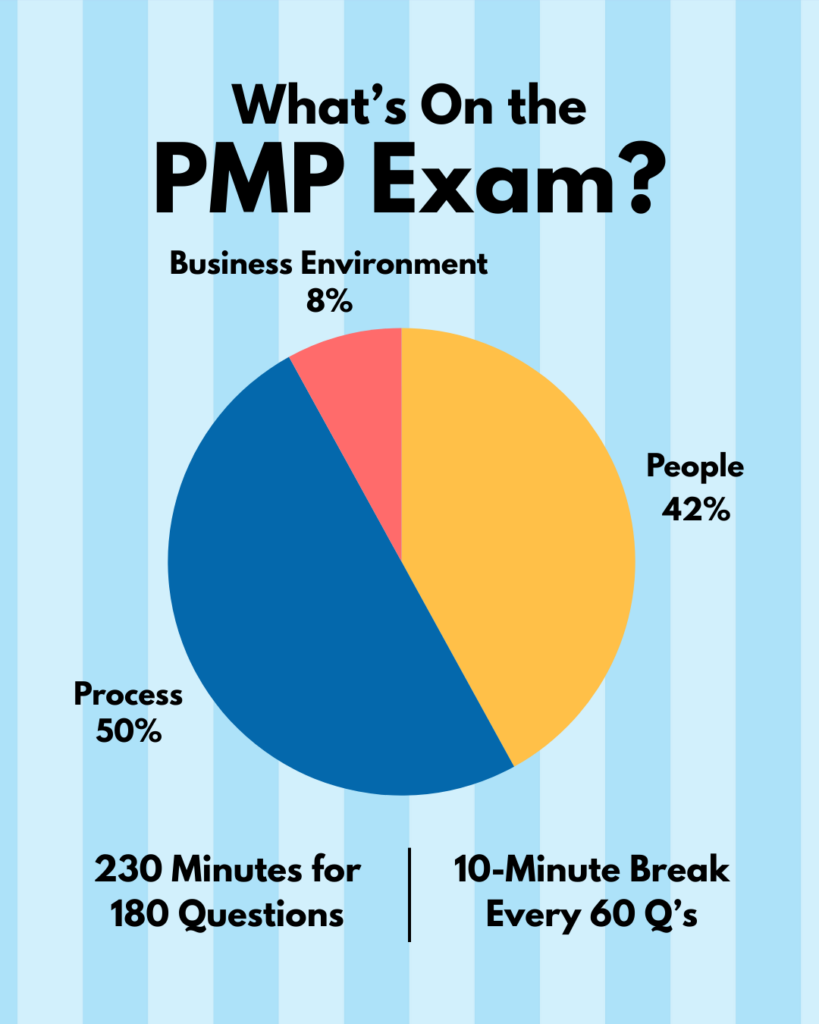
The PMP exam is based on the Project Management Body of Knowledge (PMBOK Guide) and covers three key areas called “domains:”
📌 People (42%)
- Leading teams and keeping them motivated
- Conflict resolution and stakeholder communication
- Managing performance and team development
📌 Process (50%)
- Managing project schedules, budgets, and risks
- Agile and predictive project management approaches
- Measuring project progress and adjusting strategies
📌 Business Environment (8%)
- How projects fit into an organization’s goals
- Managing compliance and external business factors
The test isn’t just multiple-choice—it’s a mix of scenario-based questions, multiple responses, and fill-in-the-blank calculations.
PMP Exam Format: What to Expect on Test Day
The PMP certification exam is a 230-minute test (nearly four hours) with 180 questions. Here’s the breakdown:
- Multiple-Choice, Multi-Response, and Drag-and-Drop Questions
- Two 10-Minute Breaks (after every 60 questions)
- No Scheduled Exam Dates—you can take it year-round in a testing center or online.
The minimum passing score has yet to be officially published, but estimates suggest you need 65-70% correct answers to pass.
👉 Pro Tip: You can take the exam in person at a Pearson VUE testing center or online from home (but you’ll be monitored via webcam).
How Much Does the PMP Exam Cost?
The PMP certification process isn’t cheap, but it’s well worth the investment in your career, considering the six-figure payoff. Currently, the exam costs are as follows:
📌 PMI Members: $425
📌 Non-Members: $675
📌 Retake Fee: $275 (members) / $375 (non-members)
💡 Should you become a PMI member? It costs $164 per year, but members get a $250 exam discount—so if you plan on taking the exam, it pays for itself.
PMP Exam Pass Rates: How Hard Is It?
The PMP exam is challenging, with an estimated pass rate of around 60-70%. So, approximately 1 in 3 students leave the exam room with a failing score.
Why is it so hard? Because it’s not just a memorization test—it’s about applying project management concepts to real-world scenarios.
That’s why exam prep is so important.
One successful PMP shares,
“The exam is tough. It requires application of the knowledge you acquired by giving you scenarios. Two of the four choices provided are very similar, making you doubt yourself. If you persist, spend some time to know the basics, learn the concepts, and do some practice tests. You can do it.”
How to Prepare for the PMP Exam (And Actually Pass!)
Passing the PMP exam takes serious preparation. Here’s how to set yourself up for success:
📌 Step 1: Choose the Right Study Materials
- PMBOK Guide – The official source, but can be dry to read.
- PMP Exam Prep Books – Many project managers prefer simpler study guides.
- Online PMP Certification Training – You need 35 hours of training anyway, so choose a top PMP course that explains concepts clearly.
📌 Step 2: Take Practice Tests
- Mock exams help you get used to the format and time pressure.
- Aim for 70% or higher on practice tests before scheduling your exam.
📌 Step 3: Join a Study Group
- Many PMP certification holders say study groups helped them stay accountable.
📌 Step 4: Use Exam Strategies
- Eliminate wrong answers first.
- Watch out for tricky wording! PMI loves to test real-world applications, so read each question carefully.
One successful test taker gives one of the most helpful hints I’ve found, saying,
“It really helped me to look at how the PMI wrote wrong answer choices. Often, there was a theme. The wrong answers were all “do,” and the right one was “review/analyze, then take action.” I was able to apply this over most questions to quickly narrow down my options.”
Final Thoughts
The PMP certification exam is challenging, but if you put in the work, it’s worth it. Not only can it increase your project management salary, but it also opens doors to better job opportunities in project management-oriented roles.
If you’re ready to take the next step, start by choosing the right PMP certification training and setting up a study plan that works for you. Before you know it, you’ll get to add “PMP” to your resume—and your paycheck!
FAQs
Yes, it’s challenging! The PMP exam tests real-world application, not memorization, which is why solid preparation is essential for aspiring project management professionals.
For PMI members, the exam costs $425, while non-members pay $675. Retake fees range from $275 for members to $375 for non-members.
Yes! Many candidates pass with 8–12 weeks of focused study, using structured exam prep courses and practice tests.
No. PMI requires 35 hours of project management education, which you can complete through a PMP course or CAPM certification.
PMI doesn’t publish an official passing score, but estimates suggest you need around 65–70% to pass.