Yeah, that’s how many different Praxis exams there are.
With different test codes, topics, and scoring requirements, studying for the wrong one could waste weeks of prep. As a test prep reviewer, I know how overwhelming that can get without a clear starting point.
In this guide, I’ll break down how to study for the Praxis exam, build a realistic plan, and choose resources that actually help.
Key Takeaways
- Confirm your exact Praxis test code first.
- Take a diagnostic before reviewing everything.
- Spend more time on weak and heavily tested topics.
- Consider a prep course when you need more structure.
- Review explanations instead of only tracking scores.
- Complete at least one timed practice exam.
New to the exam? Start with what the Praxis exam is before building your study schedule.
Confirm Your Exact Praxis Test
Before buying a book or opening a study guide, make sure you have the right exam.
Praxis tests with similar names can cover different material. Your state, teaching subject, and grade level determine which one you need.
Check these details:
- Exam name
- Four-digit test code
- Required passing score
- Question types
- Testing time
- Content categories
Do not rely on what another teacher took. Their state or licensing path may be different from yours.
Learn What Your Praxis Test Covers
Find the content outline for your exact test code and use it as the base of your study plan.
It should show:
- Topics covered
- Approximate weight of each section
- Question types
- Sample questions
- Scoring information
Turn the content outline into a checklist. Mark each topic as strong, needs review, or completely unfamiliar.
This gives you a better starting point than reading a prep book from page one and hoping everything sticks.
Take a Diagnostic Before You Start Reviewing
A diagnostic shows what you already know and where your score is losing points.
Take one before studying. The score may not be great, but that is the point. You need an honest starting place.
| Result | What to Do |
|---|---|
| Strong Topic | Review each week briefly |
| Inconsistent Topic | Practice until your scores become steady |
| Weak Topic | Relearn the material before answering more questions |
Do not spend half your study time reviewing topics you already know just because they feel comfortable.
Build a Study Schedule You Can Actually Follow
Your schedule should fit your real life, not the imaginary version where you study three hours every night without getting tired.
Work backward from your test date. Give weak topics more time and leave the final week for mixed review and full practice exams.
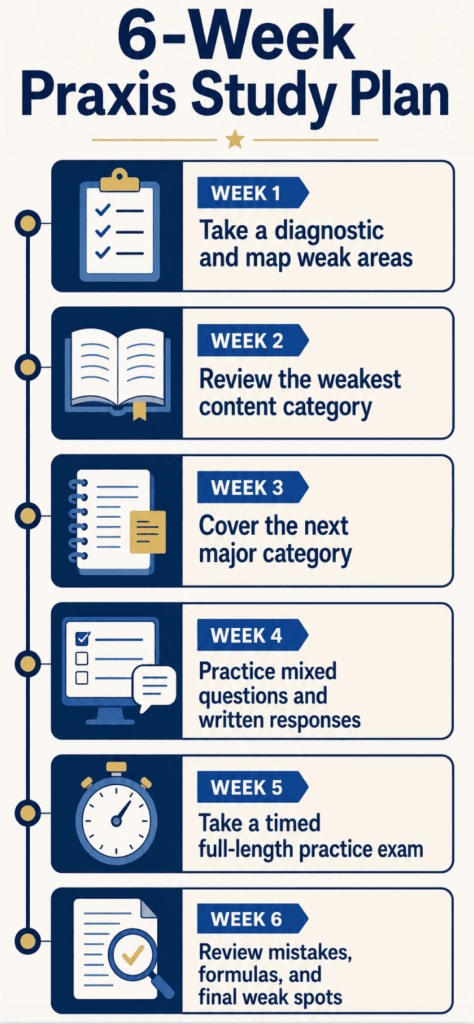
Sample Six-Week Praxis Study Plan
- Week 1: Take a diagnostic and map weak areas.
- Week 2: Review the weakest content category.
- Week 3: Cover the next major category.
- Week 4: Practice mixed questions and written responses.
- Week 5: Take a timed full-length practice exam.
- Week 6: Review mistakes, formulas, and final weak spots.
A shorter timeline can still work, but you may need longer sessions. With several months, spread the same steps out and keep each study day lighter.
Spend More Time Where the Points Are
Not every content category takes up the same amount of your exam.
A heavily tested section deserves more study time. A tiny category should not take over your entire week just because it is the one you dislike most.
Try dividing your study time like this:
- 50% on weak, heavily tested topics
- 30% on average areas that need more practice
- 20% on strong topics and quick review
These percentages do not have to be exact. The point is to study based on your score potential instead of treating every chapter equally.
Use Active Study Methods
Reading notes repeatedly can make the material look familiar without proving you can answer questions about it.
Mix reading with something active:
- Answer practice questions
- Explain a concept out loud
- Work through problems without notes
- Make flashcards for formulas and terms
- Write short responses under a timer
- Teach the topic to someone else
- Build mixed quizzes from older material
Explaining a topic in your own words is especially helpful for Praxis exams with written responses. When you cannot explain it clearly, you probably need another round of review.
Review Every Missed Practice Question
Practice questions only help when you review what happened afterward.
For each missed question, ask:
- Did I not know the content?
- Did I misread the question?
- Did I forget a formula or rule?
- Did two answers look too similar?
- Did I rush?
- Did I change a correct answer?
Keep a simple mistake log with the topic, reason you missed it, and correct takeaway. Check that list every few days so the same mistake does not keep following you around.
Practice the Question Types on Your Exam
Some Praxis exams only use selected-response questions. Others include essays, numeric-entry questions, or short written responses.
Your prep should match the real format.
| Question Type | Best Way to Practice |
|---|---|
| Selected Response | Explain why each wrong option is wrong |
| Math or Numeric Entry | Solve without looking at answer choices |
| Essay | Plan and write under a timer |
| Short Response | Give clear answers without extra filler |
| Classroom Scenario | Identify the teaching principle being tested |
Do not spend weeks using only flashcards when your exam expects you to write essays or solve multi-step problems.
Take a Full Timed Practice Exam
A full practice test checks more than your memory. It shows whether you can stay focused, manage time, and keep answering questions when your brain is tired.
Try to copy real testing conditions:
- Use the full time limit.
- Put away your phone and notes.
- Take only permitted breaks.
- Use the allowed calculator when needed.
- Finish the exam in one sitting.
Review your answers after a short break. Write down which topics caused the most trouble and whether time became a problem near the end.
One high score is nice, but steady scores across different question sets tell you much more.
When you are choosing resources, See our top Praxis study guides to compare courses, practice tests, and study plans for your exact test code.
How a Praxis Prep Course Can Help
A Praxis prep course can put lessons, practice questions, and a study schedule in one place. This saves you from piecing together random resources and deciding what to study every day.
Some courses use a diagnostic to find weaker areas and recommend what to review next. Depending on the course, you may also get:
- Video lessons
- Full content review
- Practice quizzes
- Timed practice exams
- Flashcards
- Progress reports
- Tutoring or instructor help
A course is not required, but it can help when you need more structure or have not studied the subject in a while. Make sure it covers your exact Praxis test code before signing up.
What to Do During Your Final Week
The final week is for tightening things up, not teaching yourself half the exam from scratch.
Focus on:
- Your mistake log
- Important formulas
- Heavily tested topics
- Common question traps
- One final timed exam
- Testing rules and ID requirements
Slow down the night before. Staying up until 3 a.m. to squeeze in one more chapter will probably hurt more than it helps.
My Final Thoughts
Praxis prep gets much easier once you stop trying to study everything equally.
Start with your exact test code, find the areas costing you points, and build your schedule around those. Use a prep course when you want a clearer path, or create your own routine with lessons and practice questions that match the exam.
You do not need a perfect study routine. You need one you can follow long enough to improve.
FAQs
How long should I study for the Praxis?
It depends on your starting score and exam. Many people study for several weeks, while harder Subject Tests may need a few months.
How many hours a day should I study?
Start with 30 to 90 focused minutes. Longer sessions are not automatically better when you stop paying attention halfway through.
Are Praxis prep courses worth it?
They can be when you need structured lessons, practice exams, and help deciding what to study next. Choose one built for your exact test code.
Should I study every Praxis topic equally?
No. Give more time to weak areas and categories that make up a larger part of the exam.
What should I do if I keep failing practice tests?
Pause the full exams for a few days. Review the missed topics, complete smaller practice sets, and return to full tests once your accuracy improves.