Language learning is one of the most rewarding and challenging skills you can take on. In the United States, only about 23% of people are bilingual, despite the country having the fourth-largest overall bilingual population in the world. Whether you’re learning Spanish for a summer trip to Puerto Vallarta, picking up French to gain a competitive edge at work, or studying Norwegian to honor your family history, the process of learning a new language follows a general structure, one that can be adapted to any target language with the right tools and mindset.
This article walks through the core stages of language acquisition, from beginner basics to conversational fluency, followed by a breakdown of methods, resources, and smart strategies used by successful language learners.
Key Takeaways
- Start with a Strong Foundation: Focus on basic vocabulary, pronunciation, and phrases to build early confidence and comprehension.
- Practice All Four Core Skills: Reading, writing, listening, and speaking should be developed in tandem for balanced language growth.
- Fluency Comes from Use: Speaking regularly, even imperfectly, accelerates progress more than passive study alone.
- Mix Tools for Best Results: Combine apps, courses, tutors, and media for a comprehensive, flexible approach to language acquisition.
- Consistency Beats Perfection: Daily engagement, even in small doses, is more effective than sporadic intensive sessions.
Stage 1: Laying the Foundation
Before you can hold basic conversations, you need a strong foundation. This includes developing familiarity with pronunciation, essential grammar structures, and basic vocabulary. At this stage, it’s not about mastering every detail. It’s about exposure and repetition.
Key Priorities
- Learn the alphabet and pronunciation system (especially if it’s different from your native language)
- Memorize basic phrases for greetings, introductions, and daily life
- Focus on listening and repeating to build a feel for the rhythm and sound of the language
This is the stage where consistency matters most. Even short sessions, 15–20 minutes a day, can lead to strong results over time.
Tip: Consider picking one of the easiest languages to learn.
Stage 2: Developing Core Language Skills
Once you’re past the introductory phase, the goal shifts to developing the four core language skills:
- Listening: Understand native speakers through audio, video, or live interaction
- Speaking: Build your speaking ability through guided practice or a language partner
- Reading: Work with short texts to expand vocabulary and understand sentence patterns
- Writing: Start with simple sentences to reinforce grammar and word order
At this point, grammar practice becomes more structured. You’ll want to focus on verb tenses, sentence construction, and handling unknown words without translating everything.
Stage 3: Gaining Conversational Fluency
Conversational fluency doesn’t mean speaking perfectly; it means being able to communicate ideas, respond naturally, and function in common situations. By this stage, you’ll be ready to:
- Discuss familiar topics with ease
- Ask and answer questions fluidly
- Express opinions and describe events in the past or future
Fluency is built through active use. The more you speak, write, and think in the second language, the faster you’ll progress. Don’t be afraid to make mistakes; language learning is a trial-and-error process.
Stage 4: Refining and Expanding
Advanced learners focus on refining their grammar, building topic-specific vocabulary, and understanding nuance, humor, and cultural references. Exposure to media, literature, and native-level conversation is key.
This is also the stage where language learners benefit from immersion. Whether that includes travel, local meetups, or even virtual communities where the foreign language is used daily.
Proven Tools and Language Learning Methods
While the learning process looks similar across languages, the tools and language learning methods you choose will shape how fast and how well you learn.
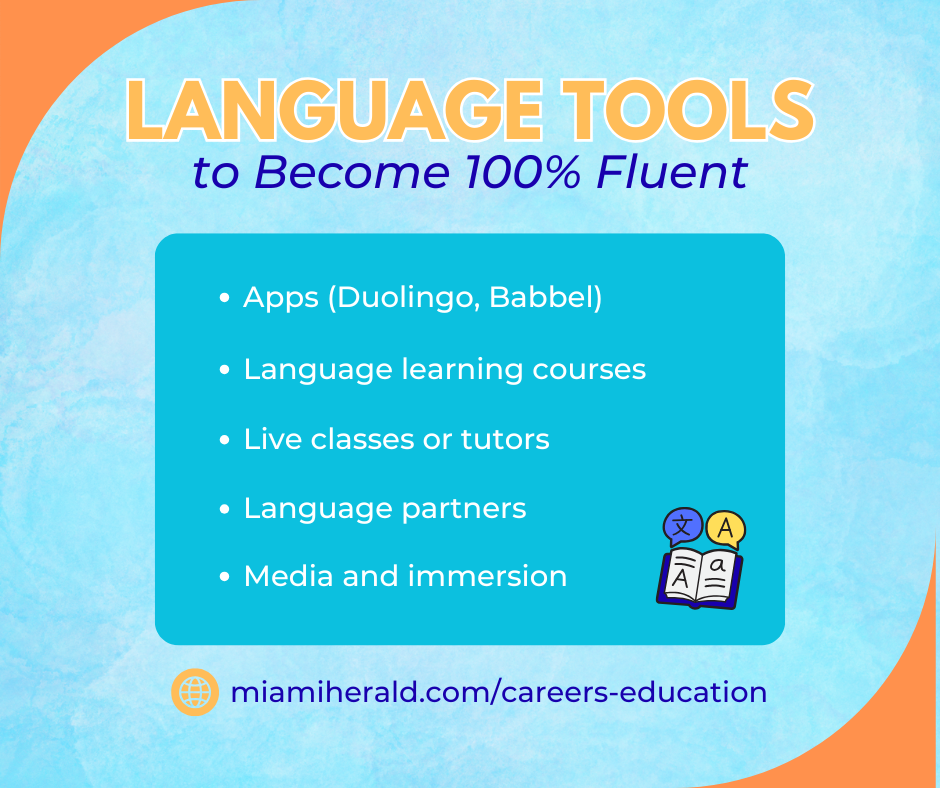
1. Language Apps
Apps like Duolingo, Babbel, and Pimsleur are designed for consistency. They help reinforce grammar and vocabulary through short lessons and gamification. These are great for beginners, but should be supplemented with other tools for real conversation skills.
2. Language Courses
A structured language course, whether online or in-person, provides depth and accountability. Look for programs that include speaking practice, grammar instruction, and cultural context, not just rote memorization.
3. Language Classes or Tutors
Group language classes can provide social learning and conversation opportunities, while tutors offer personalized instruction. Both are especially useful when working toward specific goals or tests.
4. Language Partners and Conversation Exchanges
Practicing with a language partner, a native or fluent speaker, accelerates learning by simulating real conversation. You can find partners through exchange sites, community events, or local meetups.
5. Media and Immersion
Watch TV shows, listen to music or podcasts, and read books or news in your target language. Even 15 minutes a day of passive listening can improve comprehension dramatically.
Top Language Learning Tips
Looking for unique approaches, or tips and tricks I haven’t covered yet? You’re in the right section.
Unique Language Strategies
“Video games have been the foremost tool in learning my TL. Many modern games have professionally done translations for many common languages. You’re surrounded by hovering vocabulary so you’re passively absorbing words all the time. There’s hours and hours of vocabulary spoken by professionally voiced actors with the words appearing on the screen.”
(Source: Reddit)
“One thing that is rarely brought up, and that has been super effective for me, is watching sport with broadcasting in your targeted language. It ticks all the boxes. You’re getting comprehensible input since you’re literally watching what is being described, it’s super repetitive as the same sentences will come up over and over again. You can easily shadow what has been said or imitate athletes in post-game interviews.”
Learning and Motivation Tips
“Use the language. Speak the language. Read it. Write in it, maybe keep a diary in the language. Set those little goals for yourself, sure, and then carry them out. You should spend a minimum of several hours a week if you hope to improve. It’s not as scary or as onerous as it looks: ten words a day, which you can cover in half an hour, is 3650 words a year – enough to have a decent conversation.”
Oscar Tay
“Sounding cool because you know a language just isn’t enough of a reason to learn. John told me that you need a “tangible, clear and emotional” reason why.”
Hunting the Muse
Final Thoughts
If you’re wondering how to learn a new language, the answer lies in commitment, strategy, and immersion. The fastest gains come from using the language daily. Whether through learning apps, formal instruction, or casual conversation. Every learner moves at their own pace, but with consistent exposure, regular speaking practice, and a mix of structured and informal learning, fluency is absolutely within reach.
Remember, every native speaker was once a beginner, too. Start with the basics, build steadily, and enjoy the process of unlocking a new way of seeing and saying the world.
FAQs
Begin with the basics, alphabet, sounds, and common phrases, and practice daily using apps or beginner courses.
Time varies by language and effort, but conversational fluency can be reached in 6–12 months with consistent, active practice.
Courses help, but you can also achieve fluency through a combination of self-study, speaking practice, and immersion.
Apps are a great supplement, but shouldn’t be your only method. Speaking and listening to real people is essential for fluency.
Speaking and listening are often the most crucial for daily communication, but reading and writing support long-term retention.