Let’s be real—passing the bar exam is tough. And if you’re wondering how many chances you’ll get, you’re not alone. Whether you’ve already taken it once or are still mapping out your game plan, it’s normal to ask: How many times can I take the bar exam?
Well, for 29 states, as many times as you’d like. But for 21, there are limits.
Ultimately, it depends on the state. Some places let you take the bar exam multiple times without restrictions. Others have rules—some flexible, some not so much. So, let’s break it down: the limits, the exceptions, and how to plan if you’re facing more than one round of testing.
Key Takeaways
- Most States Allow Unlimited Tries: The majority of jurisdictions let you take the bar exam as many times as needed without restrictions.
- Some States Set Attempt Limits: A few states have discretionary or absolute limits, ranging from 3 to 6 attempts, depending on the jurisdiction.
- Discretionary Extensions Are Possible: States like Texas and West Virginia may allow more attempts if you meet specific conditions or show improvement.
- Know Your State’s Policy Early: If your state has a cap, plan ahead to avoid surprises and make each attempt count.
- Failing Doesn’t Define You: Many people pass on their second or third try—it’s common, and what matters is how you move forward.
Most States Don’t Limit Bar Exam Attempts
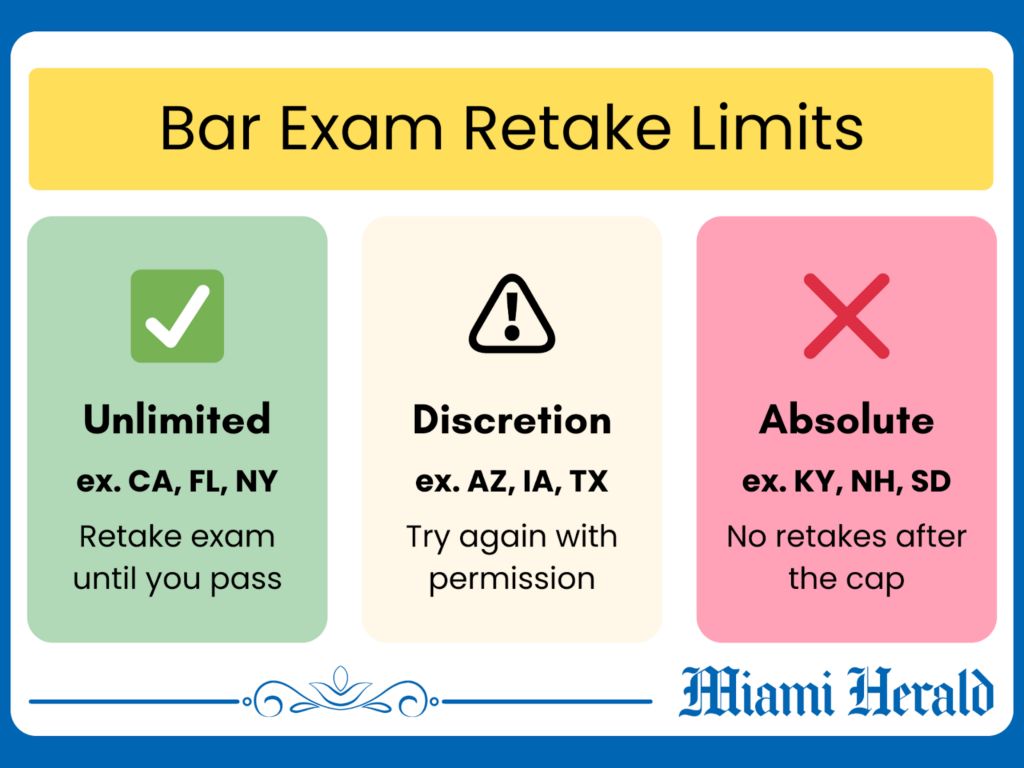
If you’re in one of the many states that don’t place a cap on bar exam attempts allowed, you’re in luck. That means you can retake the bar as many times as needed—no questions asked.
Here are just a few states where there’s no imposed limit:
- California
- New York
- Florida
- Illinois
- Washington
So, if you’re taking the California Bar Exam, for example, you can keep trying until you pass. There’s no need to file petitions or get approval. You just register for the next bar exam, show up, and give it another shot.
This approach reflects that passing the bar doesn’t always happen on the first try, but that doesn’t mean you won’t make a great lawyer.
Some States Have “Discretionary Limits”
Other states allow you a set number of attempts, but if you reach that limit, you may still be able to retake the exam with special permission. These are called discretionary limits.
Here’s what that might look like:
- Texas: Allows 5 attempts. After that, you’ll need approval from the State Bar to try again.
- West Virginia: Sets a 4-attempt cap, but you can apply for additional chances under extraordinary circumstances.
- South Carolina: Gives you 3 attempts and then requires you to petition for more.
In these cases, you’re not entirely out of options, but the process gets more involved. You’ll likely have to demonstrate that you’ve taken your preparation seriously—maybe by completing a new bar prep course or getting tutoring support.
A Few States Have Absolute Limits
Some jurisdictions have hard limits—meaning, once you hit that number, you’re done. No appeals. No extra chances. These are known as absolute limits, and while they’re rare, they’re important to know about.
For example:
- Rhode Island: Maxes out at 5 attempts.
- New Hampshire: Allows only 4.
- South Dakota: Caps you at 3.
In these states, once you hit the ceiling, that’s it—you won’t be eligible to sit for the bar again unless you move to a different jurisdiction that doesn’t enforce the same limit.
That’s why it’s so important to understand the rules early if you’re taking the bar exam in a state with limits. Planning ahead could determine whether you can keep pursuing your goal to practice law.
Why Do Some States Limit Attempts?
There’s no single reason, but it mostly comes down to administrative policy. Some state bars believe repeated failures could signal a need to pursue a different path or get more education. Others want to ensure their licensed attorneys meet a particular baseline of preparation before permitting them to practice.
That said, these rules aren’t about punishing test-takers—they’re meant to uphold consistency in licensing. And in some cases, states with limits still offer flexibility with discretionary extensions or special cases.
What About the MPRE?
It’s worth noting that many jurisdictions also require you to pass the Multistate Professional Responsibility Examination (MPRE) before you can be licensed. Thankfully, there’s no known limit on how many times you can take the MPRE.
So, if ethics questions trip you up (hey, it happens), you can retake the exam as needed until you pass.
What If You’ve Failed More Than Once?
If you’re on your second, third, or even fourth try, you’re not alone. Failing the bar doesn’t mean you’re not smart or dedicated enough. Sometimes it’s about test anxiety. Sometimes it’s just about needing more time with the Multistate Bar Examination (MBE) subjects or additional writing reps on performance tasks.
Here are a few things that can help between attempts:
- Take a new bar prep course: Especially if your last one didn’t work for your learning style.
- Do more practice questions: Focus on timing, not just content.
- Try mock exams under real conditions: Simulate the real deal to reduce nerves.
- Talk to mentors or tutors: A second set of eyes can make a huge difference.
And of course, make sure you’re studying according to the Uniform Bar Examination format if you’re in a UBE jurisdiction. Knowing the format inside and out is half the battle.
Bottom Line: Know Your State’s Rules
Here’s the TL;DR on how the bar exam varies in attempts allowed:
- Unlimited attempts: Most states, including California, allow you to take the bar as many times as needed.
- Discretionary limits: States like Texas or West Virginia give you a set number of tries, but you can apply for more with approval.
- Absolute limits: A few states don’t offer extra chances. Once you hit their limit, that’s it.
No matter where you’re testing, your best move is to check with your state bar early on. That way, if you need to pivot—whether that means studying longer, taking the test in another jurisdiction, or adding a prep course—you’ll be ready.
Final Thoughts
You can take the bar exam more than once; plenty of people do. The real question is: what’s your plan if it takes more than one try?
If you know your state’s rules, stay organized, do thorough exam preparation, and keep learning from each attempt, you’re already ahead of the game. The path to becoming a lawyer isn’t always a straight line, but it’s still yours to walk.
No matter how many times you take the bar exam, what matters most is that you keep going. Because as long as your jurisdiction allows it—and you’re willing to keep putting in the work—there’s still a seat at the table with your name on it.
FAQs
In most states, there’s no limit to how many times you can take the bar exam. You can retake it as often as needed until you pass.
That depends on your state. In some jurisdictions, nothing changes. In others, like South Carolina or West Virginia, you may need permission for additional attempts.
A few states, including Kentucky, New Hampshire, and South Dakota, place hard limits on attempts. Others have discretionary limits, allowing more tries with approval.
Wisconsin is the only state that allows certain law school graduates to be admitted without taking the bar, through a process called diploma privilege. Oregon, Washington, and New Hampshire also offer alternative pathways.
It’s more common than you might think. Depending on the year and jurisdiction, first-time pass rates range from 60% to 80%. Many successful lawyers failed once (or more) before passing.