One of the most common questions in language learning is also one of the trickiest: How long does it take to become fluent in a language? The answer depends on several variables, including your native language, the target language you’re studying, the method and intensity of your practice, and how you define language fluency in the first place.
That said, there is solid research—particularly from the Foreign Service Institute (FSI)—that offers concrete estimates based on how long it typically takes native English speakers to achieve professional working proficiency in various foreign languages. These can be a helpful starting point, even though individual timelines will vary. Allow me to lay out the facts for you to get you on the right path.
Key Takeaways
- Fluency Depends on the Language: The more structurally different the language is from English, the longer fluency typically takes.
- Time Ranges Widely: It can take anywhere from 6 months to over 2 years to become fluent, depending on the language category.
- Immersion Accelerates Learning: Living in a country where the target language is spoken significantly speeds up language acquisition.
- Practice Consistency Matters: Daily, focused practice leads to faster progress than sporadic study, regardless of the language.
- Motivation and Tools Are Key: Access to quality resources and strong personal goals often make the biggest difference in long-term success.
What Does “Fluency” Actually Mean?
Before diving into time estimates, it’s important to clarify what it means to be fluent in a language. Fluency doesn’t have a strict definition. Some people define it as being able to hold casual conversations; others interpret it as near-native mastery. For the sake of this discussion, we’ll refer to basic fluency as the ability to speak, read, write, and understand the language well enough for everyday use in work and social contexts—what the FSI refers to as professional working proficiency.
FSI Estimates for English Speakers
The FSI categorizes languages into four broad groups based on how long it typically takes a dedicated learner to reach fluency. These estimates assume full-time study at a government-sponsored language school—roughly 25 classroom hours per week, plus homework and immersion.
| FSI Category | Estimated Time | Language Examples |
| Category I | 24–30 weeks (552–690 hours) | Spanish, French, Italian, Portuguese, Norwegian |
| Category II | ~36 weeks (828 hours) | German, Indonesian, Swahili, Haitian Creole |
| Category III | ~44 weeks (1,012 hours) | Russian, Polish, Greek, Hindi, Vietnamese |
| Category IV | 88+ weeks (2,200+ hours) | Mandarin Chinese, Arabic, Japanese, Korean |
As you can see, the timeline varies significantly depending on how different the foreign language is from English in terms of grammar, pronunciation, writing system, and vocabulary words.
One Redditor explains,
“As an English speaker, for Spanish, Portugese, or Norwegian, about 6-9 months each. If you learned Spanish before, Portugese comes with a huge discount and vice versa. For German alone, about 9-12 months. If you learned Norwegian before, German comes with a slight discount and vice versa.”
So it’s also worth considering whether you’d be interested in a bundle deal: learn one language, and you’ll quickly pick up similar ones.
Factors That Influence How Long It Takes
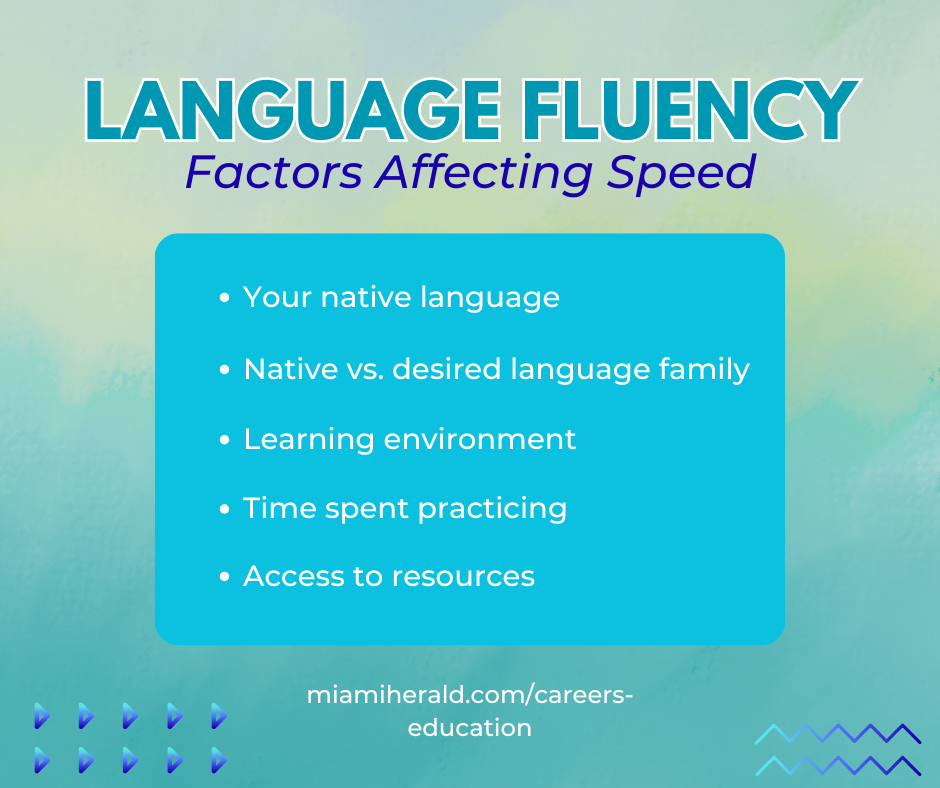
While the FSI offers a useful baseline, the real answer to fluency length depends on several additional variables:
- Your native language: The closer your native tongue is to the target language, the easier the transition. Spanish is typically easier for English speakers than Japanese.
- Language family proximity: Languages that belong to the same family—such as the Slavic languages or Germanic languages—share structures and vocabulary that ease learning.
- Learning environment: Immersion in a Spanish-speaking country, for example, will generally speed up acquisition much more than classroom learning alone.
- Time spent practicing: Consistency matters. Someone studying two hours a day will progress faster than someone doing two hours a week.
- Access to resources: Quality language schools, tutors, apps, or media can dramatically improve comprehension and retention.
- Motivation and learning habits: Strong motivation, regular review, and intentional skill-building all help learners achieve language proficiency faster.
Fluency Isn’t Linear
One of the misconceptions in language acquisition is that progress happens at a steady pace. In reality, language learning often happens in spurts. The first few hundred words may come quickly. You might feel comfortable ordering food or asking for directions in a few weeks. But hitting a true conversational level—or developing strong reading and writing skills—can take much longer.
This non-linear nature is particularly noticeable when learning Category III or IV languages, where you may experience long plateaus before breakthrough moments occur.
Average Timelines by Language Category
Let’s summarize what a realistic timeline looks like, based on intensive study (25 hours/week):
- Category I Languages: 6–8 months
These are structurally close to English. You’ll still need dedication, but fluency is relatively attainable. - Category II Languages: 8–9 months
Slightly more complex grammatically or phonetically, but not dramatically distant. - Category III Languages: Around 11 months
These often include new alphabets, additional cases, or unfamiliar sounds. - Category IV Languages: 18–24 months
These are the most complex, requiring new scripts (e.g., kanji or Arabic script), tones, and significant grammar shifts.
Measuring Fluency Along the Way
If you’re wondering whether you’re making progress, there are structured ways to assess your language skills:
- CEFR (Common European Framework of Reference): Ranges from A1 (beginner) to C2 (near-native)
- ACTFL Guidelines: Common in U.S. language assessment, from Novice to Superior
- Self-assessment tools: Many apps offer progress tracking and skill evaluations
While you don’t need to hit C2 to function fluently, having some frame of reference for your level helps set realistic expectations and goals.
Final Thoughts
So, how long does it take to become fluent in a language? For a dedicated learner, anywhere from 6 months to 2 years is typical, depending on the second language in question and the intensity of your study. The key isn’t just logging hours—it’s consistent engagement, meaningful practice, and regular exposure.
Fluency doesn’t happen overnight, but with the right approach, it’s absolutely achievable—whether you’re aiming to study abroad, connect with family, or advance your career through a new language.
FAQs
It depends on the language, your native language, and how intensively you study. Most people reach fluency between 6 and 24 months with consistent effort.
Languages like Arabic, Mandarin Chinese, Japanese, and Korean take the longest due to their complexity and distance from English.
Spanish, French, and Italian are among the quickest, typically requiring 6–8 months of intensive study to reach conversational fluency.
Yes, but it may take longer. Immersion helps, but consistent use of language apps, media, and speaking practice can still lead to fluency.
Yes. Fluency often refers to ease of speaking, while proficiency includes reading, writing, and comprehension at a functional or professional level.