Thinking about taking the SAT? Then keep reading!
Understanding how your raw score turns into your total score is vital for setting target scores and gauging your prep progress.
In 2024, about 1.97 million people took the SAT, and the average total score was 1,024, with an average of 519 in Evidence‑Based Reading & Writing (ERW) and 505 in Math.
In this guide, I’ll show you how raw answers turn into section scores and a total SAT score, how to read percentiles and benchmarks, and simple prep tips using real average scores to help you set achievable goals.
Key Takeaways
- Raw Score To Scaled Score: Correct answers are converted using statistical equating into scaled scores.
- Total Score Calculation: Your EBRW and Math section scores are combined to form your total SAT score.
- No Penalty for Guessing: There is no deduction for wrong or blank answers; only correct responses.
- Percentiles in Score Report: Your report shows comparisons with all U.S. 11th‑12th graders and recent SAT users to show how you rank.
- Adaptive Digital Format: Each section has two timed modules; module two adapts based on performance in module one, yet scores remain consistent and standardized across test versions.
SAT Scoring: The Basics
The SAT is made up of two main multiple-choice sections:
- Reading and Writing
- Math
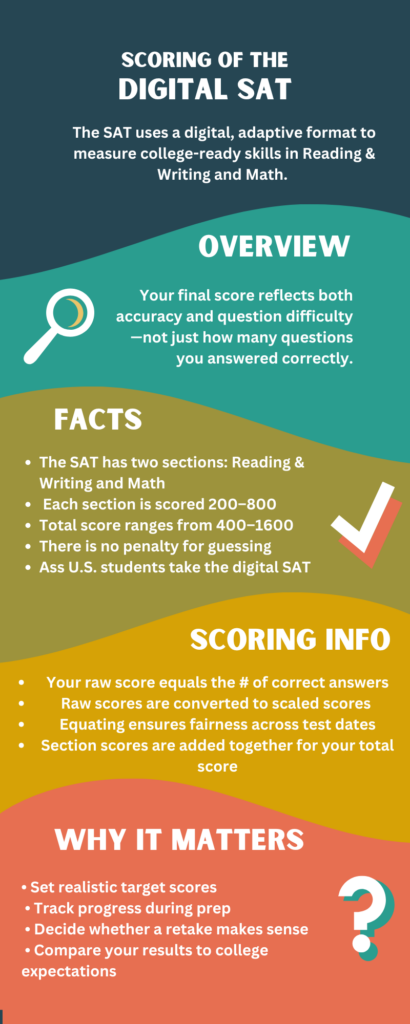
Since March 2024, all U.S. students now take the SAT in a digital format. The updated version uses adaptive testing, where how you do in the first part of each section affects the questions you get in the second. This change makes the exam shorter while still focusing on college-level skills.
Most colleges do not require a separate writing score, but strong writing skills remain essential for success on the Reading and Writing section.
Raw Score: Your Correct Answers Count
There is no penalty for wrong answers. The raw score simply equals the number of correct answers in each section.
- Omitted or incorrect answers count the same: zero.
- Scaled Scores: Why Anything Beyond 1 Point Matters.
The College Board converts your raw scores into scaled section scores on a 200–800 scale using equating tables so that test difficulty is equal across different test dates.
That means a raw math score of 51 might be worth 800 one day and 790 another, depending on the test form.
💡Note: Some Math questions require entering your own answer, not choosing from multiple-choice options.
Total Score: It’s Simple Addition
Your SAT total score is the sum of your two section scores: Reading and Writing, and Math. Here’s how it works:
Add your section scores (e.g., 710 Reading and Writing, 680 Math).
Your total score would be 710 + 680 = 1390.
There’s no averaging or rounding. The total score always ranges from 400 to 1600.
A Closer Look at Section Scores
Understanding how the SAT is scored starts with knowing what each section score measures.
Reading and Writing
Focus areas:
- Command of Evidence
- Words in Context
- Craft and Structure
- Expression of Ideas
- Standard English Conventions
Math
Focus areas:
- Algebra
- Advanced Math
- Problem-Solving and Data Analysis
- Geometry and Trigonometry
Each section is scored on a 200–800 scale, and both are combined to calculate your total SAT score out of 1600.

Score Reports: Do Percentiles Really Matter?
Along with your SAT score, you’ll see two percentiles:
- SAT User Percentile shows how your score stacks up against actual students who took the SAT in recent years.
- The Nationally Representative Percentile ranks your score against typical U.S. high school juniors and seniors, whether or not they’ve taken the SAT.
Why it matters: Percentiles add context to your score by showing where you stand among other students. They’re useful for setting goals, interpreting your results, and deciding whether a retake is warranted.
What Is a Good SAT Score?
A total score above 1200 places you well above average and can make you competitive at many public universities and moderately selective colleges.
Scores in the 1400s and higher are considered strong for more selective institutions, including top public flagships and some private colleges.
For Ivy League and top-tier schools, admitted students often score 1450–1550, but strong grades, essays, and activities matter just as much, especially at test-optional schools.
💡Pro Tip: I recommend using your score report percentiles to judge where you stand, and compare your section scores to the middle 50% range of your target schools to decide whether a retake could boost your chances.
Tips for High School Students: Prep Smart
A smarter prep plan starts with knowing what matters most on test day.
- Focus on practice questions and modules to improve raw answers
- Use SAT prep tests that mimic the adaptive testing format
- Set the target total score aligned to your college list
- Use percentile feedback to compare yourself to both SAT users and a broader national sample
Why It Matters for College Admissions
Even though many colleges no longer require test scores, most still accept them. A solid SAT score can boost your application at competitive schools or help you qualify for scholarships.
The digital SAT was redesigned to be shorter and more adaptive, but colleges still recognize it as a reliable measure of academic readiness. A solid score reflects the skills you’ll need in college and can help you stand out in a competitive applicant pool.
Even if it’s not required, your SAT score can give admissions teams another reason to say yes.
Final Thoughts
The SAT score report is more than just a total out of 1600. It breaks your performance into detailed section scores, percentiles, and skill-based subscores that colleges can use to better understand where you excel.
Understanding how each correct answer contributes to your raw score and how that becomes your scaled score gives you clarity while prepping and a strategy for retesting if needed.
It’s not only about reaching a number. It’s about using that number to make smart decisions, set realistic goals, and open the right doors for what comes next.
Know your score, trust your prep, and move forward with confidence.
FAQs
SAT scores are based on correct answers and then converted into scaled section scores.SAT scores are based on correct answers and then converted into scaled section scores.
For 2024, the average total score was 1024.
Each section has two adaptive modules: one for Reading and Writing, one for Math.
No. The SAT essay score was removed in 2021; writing is now part of ERW.
No. The digital SAT provides a calculator.