Language difficulty is not a fixed measurement. It depends heavily on your native language, your exposure to other languages, and the specific aspects of the target language you’re trying to learn. For native English speakers, the answer to “what is the hardest language to learn” will differ significantly from someone raised speaking Russian, Mandarin, or Arabic.
This article explores what makes certain languages more difficult than others, with a focus on writing systems, pronunciation, grammar, and linguistic distance. I’ll also compare languages using authoritative sources, including the U.S. Foreign Service Institute (FSI), which categorizes language difficulty based on how long it takes native English speakers to reach professional working proficiency.
Key Takeaways
- Language Difficulty Is Relative: What’s hard for one learner may be manageable for another, depending on their native language.
- Writing Systems Matter: Non-Latin scripts like Chinese characters or Arabic significantly increase the learning curve.
- Grammar Can Be a Major Hurdle: Case systems, verb aspects, and noun classes make some languages more structurally complex than others.
- Sound Systems Add Challenge: Tones, clicks, or unfamiliar phonemes can make pronunciation a long-term learning obstacle.
- Motivation Impacts Success: Consistent effort and strong personal motivation often matter more than the language’s inherent difficulty.
The Role of Native Language
Your mother tongue plays a decisive role in how easy or difficult a new language will be to learn. When two languages share vocabulary, sentence structure, or writing systems, learning becomes much more intuitive.
For example:
- English and German are both Germanic languages; while German has more complex grammar, the shared roots aid comprehension.
- Spanish, French, and Italian all descend from Latin, offering similarities in vocabulary and structure for English speakers familiar with Romance languages.
- Mandarin Chinese, on the other hand, has no linguistic overlap with English, making it considerably more challenging to learn.
Languages Ranked by Difficulty
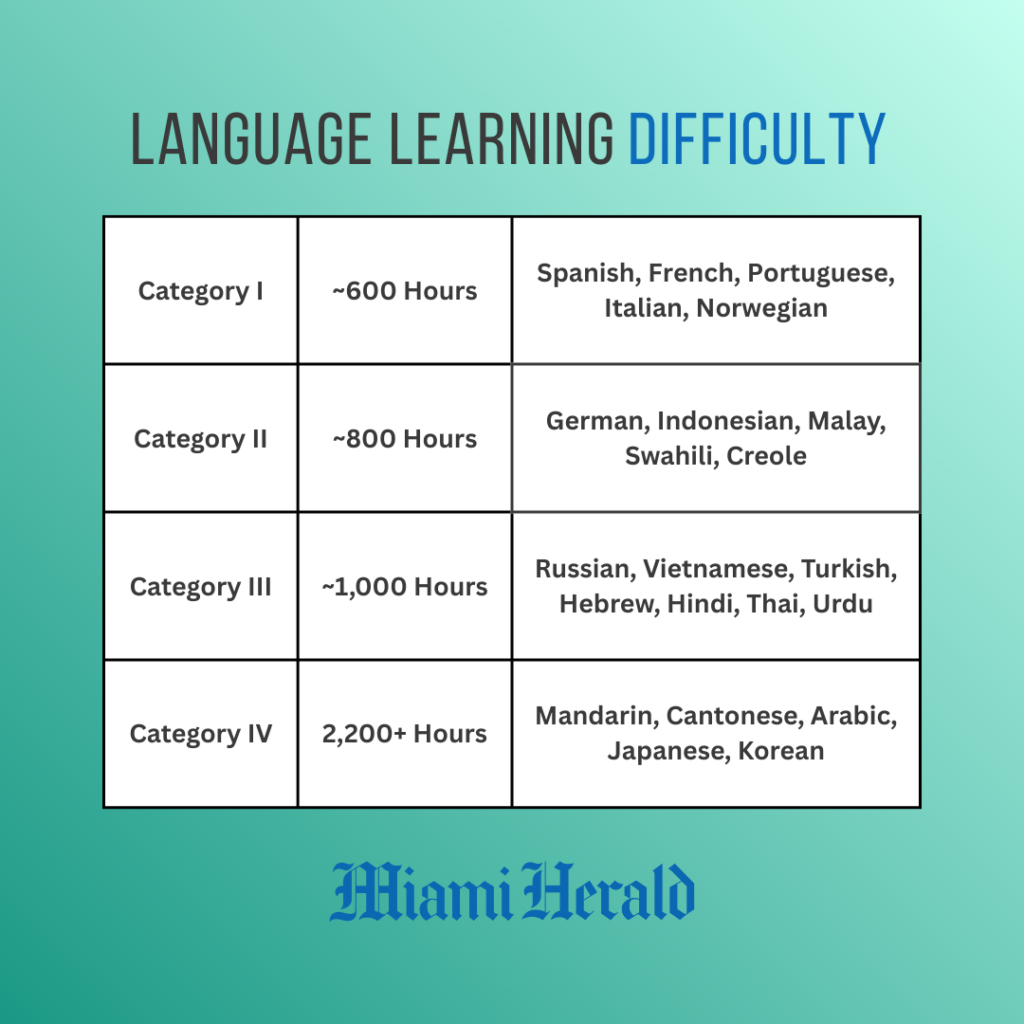
According to the FSI, languages can be grouped by the estimated number of hours needed for an English speaker to achieve proficiency. Here’s a breakdown of common examples:
| FSI Category | Estimated Hours | Examples |
|---|---|---|
| Category I | ~600 hours | Spanish, French, Portuguese, Italian, Norwegian |
| Category II | ~800 hours | German, Indonesian, Malay, Swahili, Creole |
| Category III* | ~1,000 hours | Russian, Vietnamese, Turkish, Hebrew, Hindi, Thai, Urdu |
| Category IV | 2,200+ hours | Mandarin, Cantonese, Arabic, Japanese, Korean |
Languages in Category IV are often referred to as the most difficult languages for native English speakers. They typically include unfamiliar sounds, complex grammar, and new writing systems.
*This is by far the longest category, with dozens of other entries. This table has been truncated for simplicity’s sake.
Writing Systems and Visual Complexity
Learning a new writing system significantly increases language difficulty. English speakers are accustomed to the Latin alphabet; languages using a different script require additional time just to develop reading fluency.
Examples of Challenging Writing Systems
- Chinese characters (Mandarin): Thousands of logographic symbols with no phonetic clues.
- Arabic script: Cursive, right-to-left, with letter variations based on position.
- Cyrillic alphabet (Russian): Similar to Latin in form, but different in pronunciation.
- Kana and Kanji (Japanese): A combination of phonetic and logographic characters.
In contrast, languages like Spanish or Italian use the Latin script and offer consistent phonetic rules, reducing the cognitive load for new learners.
Pronunciation and Sound Systems
Pronunciation can also determine how challenging a language is, particularly when it includes unfamiliar sounds not found in the learner’s native tongue. This is often overlooked until speaking practice begins.
Consider these challenges:
- Tonal languages (e.g., Mandarin, Vietnamese) change meaning based on pitch contour.
- Click consonants (e.g., Xhosa) involve sounds not used in most world languages.
- Deep pharyngeal sounds (e.g., Arabic) can be physically difficult to produce.
Even within familiar alphabets, pronunciation can vary widely. For instance, Portuguese pronunciation—especially from Portugal—includes nasal vowels and rapid elisions that complicate listening and speaking.
Grammar and Structure
Grammar is frequently where learners hit a wall. Some languages feature grammatical rules that are fundamentally different from English, including:
- Free word order (e.g., Russian): Sentence meaning relies more on word endings than order.
- Verb aspects (e.g., Slavic languages): Requires distinguishing between completed and ongoing actions, often with different verbs.
- Noun classes (e.g., Swahili): Multiple grammatical genders or classes, far beyond the masculine/feminine split in Romance languages.
In contrast, English is relatively analytic—meaning it uses word order more than inflection to convey meaning—making agglutinative or fusional languages harder for English speakers to grasp.
Other Key Factors in Language Difficulty
In addition to grammar, pronunciation, and writing systems, several less obvious factors can significantly influence how difficult a language feels to learn. Cultural context plays a major role—when a language is embedded in traditions, values, and social norms that differ from your own, it can be harder to internalize meaning beyond just vocabulary. Access to learning resources also matters. High-quality textbooks, apps, tutors, or online platforms can streamline the process and make self-study far more effective than working with outdated or incomplete materials.
Exposure is another powerful tool. The more you hear or use the language in daily life—through travel, community interaction, or even media—the more quickly it tends to stick. Finally, your motivation and consistency can make or break the experience. Learners with specific goals and regular study habits generally progress faster than those dabbling without a clear reason or routine. In short, difficulty isn’t only built into the language—it’s also shaped by how, why, and where you’re learning it.
So, What is the Hardest Language to Learn?
There’s no one-size-fits-all answer, but if we consider time investment, complexity, and distance from English, the following are commonly cited as the hardest for native English speakers:
- Mandarin Chinese: Due to tones, characters, and syntactic differences.
- Arabic: Complex verb forms, unfamiliar script, and regional dialect variation.
- Japanese: Multiple writing systems and levels of formality.
- Korean: While Hangul is logical, grammar and syntax differ significantly from English.
- Russian: Due to case endings, aspectual verbs, and unpredictable stress patterns.
Final Thoughts
Labeling any one language as “the hardest” misses the broader point: language learning is relative. Your native language, your past exposure to other languages, and even your goals will shape what’s hard and what’s not. A native Russian speaker might find Polish easier than German. A Brazilian might pick up Spanish faster than French. And for some, English—with its irregular spelling, idioms, and massive vocabulary—can be the hardest language of all.
In the end, the best language to learn is the one you’re motivated to stick with. Difficulty is just one part of the equation.
FAQs
Significant differences in grammar, pronunciation, and writing systems increase difficulty, especially if the language is unrelated to English.
For native English speakers, Mandarin is often ranked among the hardest due to its tones, characters, and lack of cognates.
According to the FSI, Category IV languages like Arabic or Japanese can take over 2,200 study hours to reach working proficiency.
Yes, especially if the second language is related to one you’ve already studied or if you’ve built strong learning habits.
While English has quirks and irregularities, its global exposure, extensive resources, and familiar alphabet make it easier to learn.