Language learning is deeply personal—but some languages are, objectively, more accessible to native English speakers than others. Factors like shared roots, familiar grammar rules, a common writing system, and consistent sentence structure all help reduce the challenge.
Rather than listing the usual suspects in one long paragraph, we’re exploring the easiest languages to learn by global region. We’ll highlight one primary language per area, noting its advantages, number of speakers, cultural contributions, and a few alternatives worth considering. These insights are based on the U.S. Foreign Service Institute (FSI) estimates of how long it typically takes English speakers to learn each foreign language, as well as a touch of my own personal experience with languages.
Key Takeaways
- Regional Languages Vary in Difficulty: Depending on the area of the world, some languages are significantly easier for English speakers to learn.
- Shared Roots Simplify Learning: Languages related to English—like those in the Germanic or Romance language families—tend to have simpler grammar and vocabulary overlap.
- ASL is a Unique, Visual Language: Though nonverbal, American Sign Language offers a rich cultural experience and is widely used in North America.
- Latin is the Most Learnable Dead Language: With vast resources and influence on English, Latin is the easiest entry point into classical languages.
- Learning is About More Than Utility: Whether for career, culture, or curiosity, the best language to learn is one that keeps you engaged and motivated.
Easiest European Language to Learn: Norwegian
Norwegian is often ranked among the easiest languages to learn for English speakers—and for good reason. As a Germanic language, it shares structural and lexical similarities with English. It uses the Latin alphabet, features relatively straightforward verb conjugations, and has flexible word order.
Also, it’s worth considering that Norwegian, Danish, and Swedish are all incredibly similar, so it’s like learning three languages for the price of one. Obviously, there are differences, but according to Babbel,
“Norwegian speakers are found in decent numbers in Sweden and Denmark because the mutual intelligibility of Norwegian, Swedish, and Danish allows for a lot of cultural interchange. Knowing Norwegian technically allows you to speak to about 20 million other people, even if only about 5.2 million speak Norwegian specifically.”
Why It’s Worth Learning:
- Number of Speakers: ~5 million
- Where It’s Spoken: Norway (official language), some communities in Scandinavia, and expat hubs
- Time to Learn: ~24 weeks (Category I, FSI)
- Cultural Gems:
- The Ice Palace by Tarjei Vesaas (literature)
- Films by Joachim Trier (The Worst Person in the World)
- Jo Nesbø’s bestselling detective novels
Alternatives:
- Danish and Swedish (also Scandinavian languages, mutually intelligible with Norwegian)
- Dutch (especially useful for travel or business in the Netherlands and Belgium)
- Italian and Romanian (accessible Romance languages with moderate learning curves)
Easiest South American Language to Learn: Portuguese (Brazilian)
Brazilian Portuguese stands out in South America not only for its musical rhythm and expressive vocabulary but also for its relative accessibility to English speakers. While it’s a Romance language, like Spanish or French, Portuguese pronunciation can be slightly trickier—but the grammar and vocabulary will feel familiar.
Why It’s Worth Learning:
- Number of Speakers: Over 250 million native speakers
- Where It’s Spoken: Brazil (official language), parts of Mozambique, Angola, and Portugal
- Time to Learn: ~24 weeks (Category I, FSI)
- Cultural Gems:
- Dom Casmurro by Machado de Assis (literature)
- City of God (film)
- Music from João Gilberto and Caetano Veloso
Alternatives:
- Spanish (from Spain or Latin America)—widely spoken and only slightly more time-intensive (~30 weeks)
- Note: Spanish is more prevalent across the continent, but Portuguese offers deep cultural and economic value in Brazil.
Easiest African Language to Learn: Swahili
Swahili is a fantastic entry point to African languages for English speakers. While it has roots in Bantu languages, Swahili incorporates a significant number of Arabic loanwords. It is written using the Latin alphabet, making the writing system much less intimidating than it might otherwise be.
Why It’s Worth Learning:
- Number of Speakers: Over 200 million
- Where It’s Spoken: Tanzania, Kenya, Uganda, the Democratic Republic of Congo, and surrounding regions
- Time to Learn: ~36 weeks (Category II, FSI)
- Cultural Gems:
- Siku Njema by Ken Walibora (literature)
- Rafiki (film by Wanuri Kahiu)
- East African oral storytelling and poetry traditions
Alternatives:
- Afrikaans—a descendant of Dutch, simpler grammatically, though sometimes not considered fully representative of indigenous African languages due to its colonial origins. However, it’s widely spoken in South Africa, as well as Namibia, Botswana, and Zimbabwe.
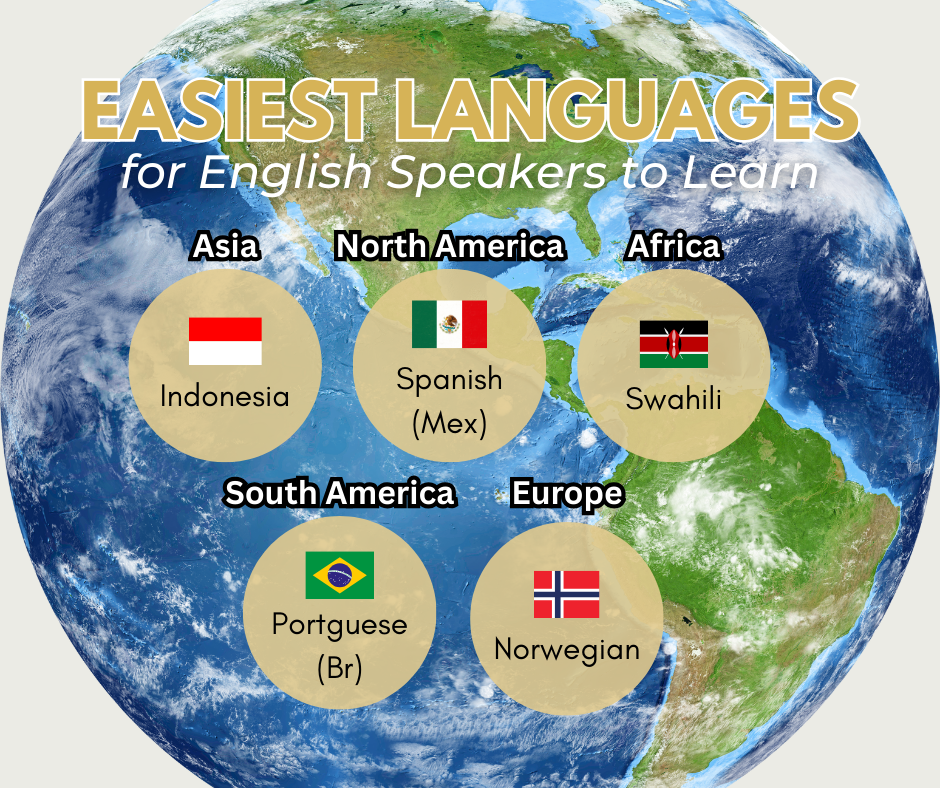
Easiest Asian Language to Learn: Indonesian
Indonesian is widely praised for being one of the easiest languages to learn in Asia. It’s a phonetic language (words are pronounced as spelled), uses no tones (unlike Mandarin or Thai), and has no verb conjugation or noun genders. It’s also grammatically straightforward, which helps reduce the language learning difficulty significantly.
Why It’s Worth Learning:
- Number of Speakers: ~200 million
- Where It’s Spoken: Indonesia (official language), Malaysia (similar language: Malay)
- Time to Learn: ~36 weeks (Category II, FSI)
- Cultural Gems:
- This Earth of Mankind by Pramoedya Ananta Toer (literature)
- The Raid (film)
- Traditional shadow puppetry (wayang kulit) and gamelan music
Alternatives:
- Malay—nearly identical structurally and spoken in Malaysia, Brunei, and parts of Singapore.
Easiest North American Language to Learn: Mexican Spanish
While Spanish is often grouped with European languages, it holds a dominant role in North America, especially in Mexico and the U.S. Being a Romance language, it shares roots with English vocabulary and has a clear, consistent writing system.
Why It’s Worth Learning:
- Number of Speakers: Over 125 million in Mexico; more than 450 million globally
- Where It’s Spoken: Mexico, large parts of the United States, Central America, and much of Latin America
- Time to Learn: ~30 weeks (Category I, FSI)
- Cultural Gems:
- Like Water for Chocolate by Laura Esquivel (literature)
- Roma by Alfonso Cuarón (film)
- Global influence of Mexican food, music, and traditions
Alternatives:
- Haitian Creole—spoken in Haiti and parts of the U.S. (especially Louisiana), ~36 weeks to learn
- French—an official language in Canada and many parts of the world, also relatively quick to learn (~30 weeks)
United States & Visual Languages: American Sign Language (ASL)
While not traditionally listed alongside spoken languages, American Sign Language (ASL) is one of the most commonly used languages in the U.S., with hundreds of thousands of native users and many more learning it as a second language. It’s a complete, natural language with its own grammar, syntax, and rich cultural history within the Deaf community.
Why It’s Worth Learning:
- Number of Users: Estimated 500,000+ in the U.S. (varies depending on data source)
- Where It’s Used: United States and parts of Canada
- Time to Learn: Varies; can take several years to master expressive fluency
- Cultural Gems:
- CODA (Oscar-winning film)
- Works by Deaf poets like Clayton Valli
- Storytelling and performance traditions within Deaf culture
What Makes It Unique:
- ASL is not based on English—it’s its own language, with different word order and grammar rules.
- It’s highly visual and spatial, which means learners must develop skills in nonverbal communication, facial expression, and physical context.
ASL offers a powerful way to connect with a vibrant community and develop a completely different kind of language fluency. For many language learners, it challenges the assumptions of what language can look like.
Just for Fun: Learning a Dead Language
Not all language learning is driven by practicality. Some people are drawn to languages that aren’t spoken in daily life anymore—but still hold immense cultural, historical, or literary value. Dead languages are no longer used in casual conversation by a native population, but they’re far from useless.
Examples Worth Exploring:
- Latin: Foundation of Romance languages, used in science, law, and theology; gateway to classical literature (often considered the easiest of the dead languages, though it isn’t “easy”)
- Ancient Greek: Language of philosophy, early Christian texts, and epic poetry
- Old Norse: The language of the Vikings, sagas, and Norse mythology
- Sanskrit: Still used in Hindu ritual and classical Indian literature
Why Study One?
- Access to original texts in law, philosophy, and religion
- Enhanced understanding of modern vocabulary, especially in medicine or academia
- Intellectual challenge and cultural enrichment
While you won’t use these in casual conversation, learning a dead language sharpens linguistic intuition, improves pattern recognition, and offers direct access to some of the world’s greatest literary and philosophical works.
Final Thoughts
So, what is the easiest language to learn for English speakers? It depends on your interests, goals, and regional focus. But based on FSI data, languages that use the Latin alphabet, have phonetic spelling, and are either Romance or Germanic languages tend to be the most accessible.
Choosing a language with global relevance and strong cultural outputs—whether that’s Norwegian literature, Portuguese music, or Spanish cinema—can also keep you motivated and immersed as a learner.
Wherever you begin, the most important thing is to start. The world has over 7,000 languages. Learning even one second language opens up new ways of seeing, thinking, and connecting.
FAQs
Norwegian, Spanish, and Portuguese are among the easiest, thanks to shared roots, simple grammar, and phonetic spelling.
ASL is highly visual and different from spoken languages, but many English speakers find it accessible with practice and proper instruction.
According to the FSI, about 24–30 weeks (600–750 hours) of study can lead to professional fluency in these languages.
Yes—Latin is considered the most approachable dead language and offers benefits in vocabulary, history, and understanding Romance languages.
Absolutely. French is widely spoken in Canada and parts of the U.S., and Haitian Creole is used in parts of Louisiana and in large Haitian communities.