Are you gearing up to conquer the CMA exam? Wondering about the exam’s difficulty or how long it might take to pass?
I’ll get straight to the point.
According to the latest CMA scores released by the IMA, you have less than a 50/50 shot at achieving a CMA pass rate. Although their latest performance report shows a slight increase in overall CMA pass rates, the historical percentage of 45 holds strong.
This isn’t necessarily good news, but exploring both recent and historical CMA exam pass rates can offer real insights for CMA candidates.
In this article, I’ll share this information with you, including pass rates for first-time exam takers, why I think this exam is so tough, and what it takes to achieve a passing score.
Key Takeaways
- Acknowledge the Odds: Understanding that the current CMA exam pass rate stands at 45% sets a realistic expectation. This statistic underscores the exam’s rigor and the level of dedication required to surpass the average.
- Recognize the Positive Shift: The recent changes to the CMA exam curriculum have led to an encouraging increase in pass rates, lifting them by 2 to 10 percent.
- Strategic Study Approach: Given the 45% pass rate, a strategic approach to studying becomes even more critical. Focus on areas of the curriculum that have been historically challenging for candidates, especially new content on technology, analytics, and strategic decision-making.
- Leverage High-Quality Study Materials: The right preparation resources can make a significant difference. Opting for high-quality study materials, CMA courses with high pass rates, engaging in discussion forums, and utilizing teaching as a learning tool are effective strategies to enhance understanding and retention.
Understanding the Latest CMA Exam Pass Rates
In a significant development, the Institute of Management Accountants unveiled the pass rates for the revamped CMA exam curriculum’s initial testing window. This period, which extended from January to February 2020, marked the year’s first of three scheduled testing intervals.
From a comprehensive pool exceeding 5,000 examinations for both Part 1 and Part 2, the IMA disclosed a global pass rate of 45% for each segment. This statistic is particularly noteworthy when juxtaposed with historical data, revealing a remarkable 10% surge in the pass rate for Part 1.
How did this happen?
This leap is attributed to the substantial updates made to the curriculum, notably the integration of technology and analytics content, reflecting the evolving landscape of management accounting.
Conversely, the pass rate for Part 2 remained consistent with prior years, standing at 45%. The modifications to Part 2 were centered around bolstering the emphasis on ethics and strategic decision-making, underscoring the critical role CMAs play in guiding their organizations through ethical dilemmas and strategic challenges.
The Evolution of CMA Exam Pass Rates
The fluctuation in pass rates, especially after notable consistency in recent times, speaks volumes. It suggests a leveling of the playing field, possibly due to better preparation resources or candidates’ adaptability to the exam’s demands.
The CMA exam underwent significant changes in its curriculum with the introduction of the 2020 content specification outline. These changes were aimed at aligning the exam more closely with the evolving skills required by management accountants in the modern workplace.
- Part 1 Enhancements: The most notable update was in Part 1, which now includes new content on technology and analytics. This addition reflects the growing importance of tech-savviness in the field of management accounting.
- Part 2 Refinements: Changes to Part 2 placed a greater emphasis on ethics and strategic decision-making, underscoring the role of CMAs in guiding ethical and strategic directions for their organizations.
Will the rise in rates continue?
It’s hard to say. Although the IMA used to release CMA exam-graded pass scores every nine months, this has slowed down with the postponement of exams.
What the Experts Say About the CMA Pass Rate Results
Dennis Whitney, CMA, Senior Vice President of ICMA, commented on these results, highlighting the hard work of candidates and the effective preparation provided by course publishers and providers. While these early results are promising, they are not necessarily indicative of future trends, but they do show a positive reception of the updated material.
Comparing CMA Pass Rates to Other Accounting Certifications
When compared to other accounting certifications, the CMA exam’s pass rates offer a unique perspective. Despite perceptions, the CMA exam’s pass rates are generally lower than those of other certifications, such as the Enrolled Agent exam and the CPA exam.
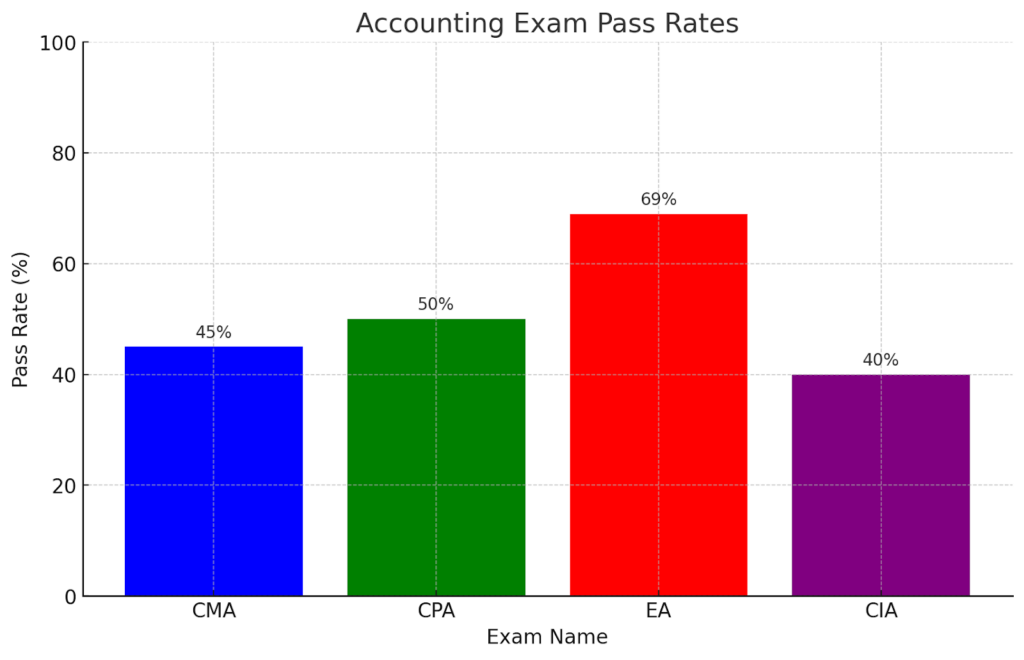
- CMA: around 45%
- CPA: around 50%
- EA (Enrolled Agent): 69%
- CIA (Certified Internal Auditor): 40%
This comparison sheds light on the CMA exam’s rigorous nature and the dedication required to succeed.
Decoding the Grading of the CMA Exam: A Closer Look
The CMA exam, a pivotal step towards earning the esteemed Certified Management Accountant (CMA) designation, is renowned for its rigorous assessment of candidates’ proficiency in management accounting, financial planning, and strategic financial management.
The grading process of this challenging exam is meticulously designed to ensure that only candidates who meet the high standards set by the Institute of Management Accountants (IMA) achieve the certification. Here’s how the CMA exam pass rates are determined and what makes the grading system both comprehensive and fair.
The CMA Exam Structure and Scoring
The CMA exam consists of two parts, each designed to test a wide range of knowledge and skills essential for management accountants. The exam parts cover critical areas such as financial reporting, planning, performance, and analytics, as well as strategic financial management. Each part of the exam is graded independently, contributing to the overall CMA certification process.
- Multiple Choice Section: Making up 75% of the total score, this section assesses candidates’ understanding through rigorous multiple-choice questions. To progress to the CBQ section, candidates must answer at least 50% of these questions correctly. This threshold ensures that only those with a solid grasp of the exam content move forward.
- Case-Based Question Section: Comprising 25% of the total score, the case-based questions challenge CMA candidates to apply concepts in practical scenarios through a short case and a series of structured response tasks. This section is particularly crucial for assessing a candidate’s depth of knowledge and analytical skills. Rather than writing full essay responses (as in the previous versions of the exam), candidates may be asked to work through formats such as numerical entry, drag and drop, and list selection, which are designed to measure applied understanding in a more objective way.
- The Minimum Passing Score: Achieving a passing score on the CMA exam is no small feat. The exam employs a scaled scoring system, where the raw scores are adjusted to a scale that ranges from 0 to 500. To pass, candidates need a minimum passing score of 360 on each part of the exam. This scaling method ensures fairness, accounting for slight variations in difficulty across different versions of the exam.
Why are the CMA Exam Pass Rates so Low?
Ever wondered why the CMA exam has such low pass rates?
Well, it’s not just a test of knowledge; it’s a marathon of mental endurance, strategic preparation, and a deep understanding of complex concepts. Here’s the scoop on what makes the CMA exam a formidable challenge:
The Breadth of Topics
- The CMA exam covers a vast array of topics, from financial planning and analysis to strategic management and risk assessment.
- Knowing the basics is not enough. The CMA exam has lower pass rates because it tests for in-depth understanding and the ability to apply concepts in various scenarios.
- This means that to get a CMA passing score, candidates must not only memorize formulas and definitions but also understand how to use them in real-world situations.
As one CMA candidate explained, “I have given 3 attempts now – one for part 1, two for part 2. I work and didn’t miss a day studying did the questions as well. Still, I was not able to clear through because I couldn’t get through the marginal analysis chapters as it was absolutely.”
Time Management
- With multiple-choice questions and case study sections to complete, time management becomes crucial for many CMA candidates, as it is for those taking the CPA exam.
- Candidates often find it challenging to allocate their time effectively between studying vast topics and practicing exam questions and don’t achieve a minimum passing score.
The Case-Based Questions Section
- The two case-based questions test more than recall. They measure how well candidates can apply CMA concepts in realistic business situations using a series of guided tasks.
- Compared to the former essay section, this format may reduce the writing burden for non-native English speakers and for candidates who are less comfortable with long written responses.
The Global Perspective
- The CMA exam requirements include a global understanding of management accounting, adding another layer of complexity for those more familiar with regional practices.
- Keeping up with international standards and practices can be an additional challenge for candidates.
What Can Be Done to Improve Your CMA Score?
Preparation is Key: Successful candidates often attribute their CMA exam success to diligent study schedules, high-quality CMA study materials, and taking advantage of the testing windows (January/February, May/June, and September/October) to optimize their exam preparations.
Teach to Learn: Organize mini-teaching sessions where you explain complex CMA concepts to friends or family members who have little to no knowledge of accounting. This will not only test your understanding but also help you remember the information better.
Gamify Your Study: Turn your study material into a game. Create flashcards, quizzes, or even a board game based on CMA topics. Compete with fellow CMA candidates or friends to make learning fun and more memorable.
Dive into Discussion Forums: Engage in online forums and discussion groups related to the CMA exam. Explaining concepts to others, debating topics, and seeing different perspectives can deepen your understanding and uncover areas that need more attention.
Practice Under Pressure: Simulate exam conditions by timing yourself on practice tests. To add a twist, set the timer to finish 10-15 minutes before the actual time limit. This can improve your time management skills and help you work faster under pressure.
Reward Milestones: Set specific study milestones and reward yourself when you achieve them. Rewards could be anything from a favorite snack to a day off from studying. This can boost your motivation and make the preparation journey more enjoyable.
Conclusion
In wrapping up our deep dive into the CMA exam pass rates, it’s evident that the path to achieving the Certified Management Accountant designation is both challenging and rewarding. The journey, marked by rigorous exams and comprehensive curriculum updates, is a testament to the evolving landscape of management accounting. The introduction of new content areas, such as technology and analytics, alongside an emphasis on ethics and strategic decision-making, reflects the profession’s dynamic nature and the critical role CMAs play in today’s business environment.
For those preparing to take the CMA exam, the journey ahead is clear. It involves leveraging high-quality study materials, engaging with the broader community through forums and discussion groups, and applying innovative study techniques to enhance understanding and retention. It’s about recognizing the value of teaching to learn, gamifying study sessions, and practicing under pressure to hone time management skills. Above all, it’s about setting milestones, rewarding progress, and maintaining a balance between rigorous study and the necessary breaks to ensure mental well-being.
FAQs
As of the latest data, the CMA exam pass rates stand at approximately 50% for both Part 1 and Part 2. This is an improvement from pre-pandemic rates, which historically hovered around 45%. The increase reflects the adaptability of candidates to the revised curriculum and enhanced preparation strategies.
The introduction of the 2020 curriculum, which included new content on technology and analytics in Part 1 and a greater emphasis on ethics and strategic decision-making in Part 2, led to a significant shift in pass rates. The first testing window under the new curriculum saw a worldwide pass rate of 45% for both parts, indicating a positive reception to the changes and an increase in preparedness among candidates.
The CMA exam is challenging due to its comprehensive coverage of topics, including financial planning, analysis, strategic management, and risk assessment. The exam tests not only the candidates’ knowledge but also their ability to apply concepts in real-world scenarios, manage their time effectively, and communicate complex ideas clearly. The rigorous assessment standards set by the Institute of Management Accountants (IMA) contribute to the exam’s difficulty.
Improving your chances of passing the CMA exam involves a combination of thorough preparation, understanding the exam format, and utilizing high-quality study materials. Developing a robust study plan, focusing on areas of weakness, and practicing time management during the exam are crucial strategies. Additionally, taking advantage of the IMA’s resources and possibly enrolling in a reputable CMA review course can significantly enhance your preparation.