Will insanity defense save man who admits to Coral Gables murders from death penalty?
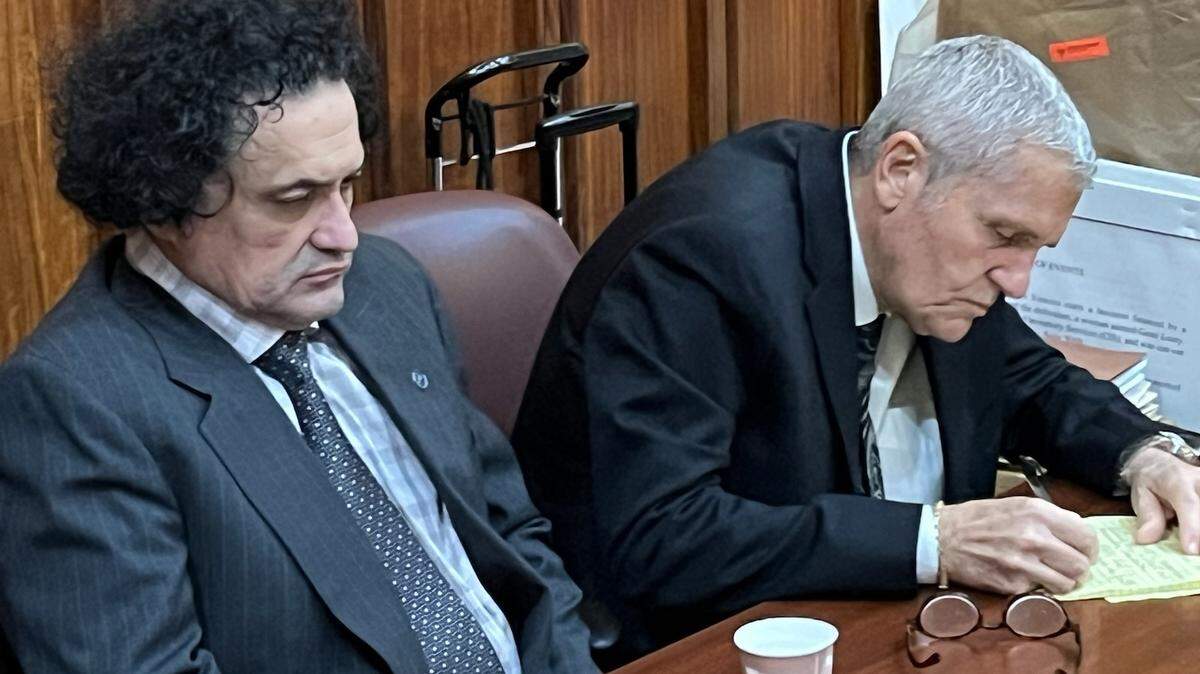
Jose Rojas admits he brutally murdered two co-workers in a Coral Gables office in 2012. But having his life spared is likely to come down to his state of mind — and whether jurors believe he was insane when he bludgeoned Frances Venezia and Robert James to their deaths.
Rojas has admitted to killing the two, but said he was insane at the time and has suffered from traumatic brain injury for decades. State prosecutors see his argument as a desperate final attempt to avoid Death Row.
According to investigators, Rojas engineered an elaborate and premeditated plan that included taking a “murder bag” with a ski mask and duct tape to the crime scene before pummeling Venezia and James with the stick end of a mop, a piece of hard ceramic, a hole puncher and paper cutter board.
“This was something very deliberate, something very planned,” Abbe Rifkin, senior trial counsel at the Miami-Dade State Attorney’s Office, told jurors during opening statements Wednesday in Miami-Dade criminal court.
But Rojas’s defense team says the former soccer standout and father of two had no recollection of the murders until he was interviewed afterward by Miami-Dade homicide detectives. They say he suffers from chronic traumatic encephalopathy, or CTE, an illness most common to football players that is manifested after years of head trauma.
“This case is not a whodunnit. Jose Rojas is responsible for the deaths of Frances Venezia and Robert James. You have to determine whether Jose Rojas was insane,” defense attorney Jimmy Dellafera told jurors. “They’ll have you believe that for $3,500, Jose Rojas premeditatively killed them? Think about what a stretch that is.”
Rojas, 55, is facing two charges of first-degree murder, two counts of kidnapping and a single count of attempted armed robbery. The trial before Miami-Dade Circuit Court Judge Miguel M. de la O is expected to last at least into next week.
Death penalty case after Florida’s new law
Rojas has been jailed for more than a decade, one of the longest stays in Miami-Dade, county records show. And, he’s one of the first death penalty defendants in Miami-Dade to fall under a new state law in which only an 8-4 jury vote is needed to be sentenced to death, as opposed to a unanimous verdict.
READ MORE: DeSantis signs death penalty bill. It could have sent Parkland shooter to death row.
According to witnesses, state prosecutors and the arrest report, Venezia operated a small insurance claims company out of a modest office in Coral Gables on Monterey Street when she and James were killed. James, a longtime family friend who did all types of odd jobs, worked there since close to its inception. Rojas, a computer technician, was hired around 2008. By 2011, the company was suffering financially and Rojas, who was earning only about $400 a week, was often being paid late.
According to Rifkin with the state attorney’s office, Rojas began embezzling from the company in December 2011. By late April of 2012, according to investigators, Rojas had used the company’s American Express card numerous times, sending himself gift cards and merchandise worth about $3,500.
But it went sideways two days before the murders, on April 25, 2012, when Rojas heard Venezia on the phone talking to American Express about the charges she wasn’t responsible for. That’s when, prosecutors contend, Rojas began to hatch his plan.
On the morning of the April 27 murders, Rifkin said Rojas drove his daughter to school, as usual, then stopped off at Winn-Dixie, which was unusual. There, he purchased a wooden mop, dish towels and duct tape. He’d already packed a bag with a ski mask and extra clothing. The BB gun he would use to subdue Venezia and James was, Rojas told police, already in his desk.
Killer’s actions on day of murder
Rifkin on Wednesday offered jurors a timeline of Rojas’s actions on the day of the murders. At one point, she told jurors, he put extra clothing on over his clothes.
“He puts on a wool black ski mask and takes off his jewelry,” she said. “Then he takes off his sneakers and puts on heavy socks. He takes the BB gun from his desk drawer and he lies in wait.”
When Venezia and James arrived for work some time after 9 a.m., police say Rojas subdued them with the real-looking BB gun, then duct taped them to chairs and devised several plans that went awry. One of the plans included Rojas forcing Venezia to call her bank and give permission for him to cash personal checks. But he soon realized that was foolhardy. Then, prosecutors contend, he beat his two victims mercilessly with several hard objects in the office.
During the hours-long incident, Venezia managed to try and contact her daughter in New York, but she didn’t answer, and James spoke with his life partner in Italy, begging for help. Police said after Rojas killed the two, he ran out of the building covered in blood. Confronted by police, he raced across Southwest Eighth Street to an alley next to a Sedanos Supermarket near the entrance to Coral Gables, where he was tackled. He was interviewed for 17 hours before finally confessing, police said.
Dellafera’s cross examination of the early witnesses Wednesday was mostly brief. He didn’t take issue with most of their answers or statements. Jurors heard from Venezia’s two children, who both said they’d met Rojas numerous times and that their mother never mentioned any type of problem with him or his well-being.
Dellafera gave jurors a hint of what to expect during the trial, during his opening statement. The defense attorney said Rojas was born prematurely just outside of Santiago, Chile, and spent almost three weeks in the hospital soon after his birth in a coma and getting blood transfusions.
By the age of 10 he’d been sexually abused by a caretaker, the attorney said, and the family was forced to move to the U.S. in fear of Chilean dictator Augusto Pinochet. Rojas, who would become a soccer star at Miami Senior High and Miami Dade College, married his high school sweetheart and had two children, but they were forced out of their home in 2009 during the Great Recession.
It was just too much for Rojas to take, Dellafera told jurors.
“In a psychotic state, Mr. Rojas broke and unfortunately blundgeoned these two individuals,” said the defense attorney. “But you should find that Mr. Rojas on April 27 was insane. He snapped.”
This story was originally published December 7, 2023 at 5:30 AM with the headline "Will insanity defense save man who admits to Coral Gables murders from death penalty?."