
Fort Lauderdale getting a $190M U.S. courthouse, while efforts mount to save the old one
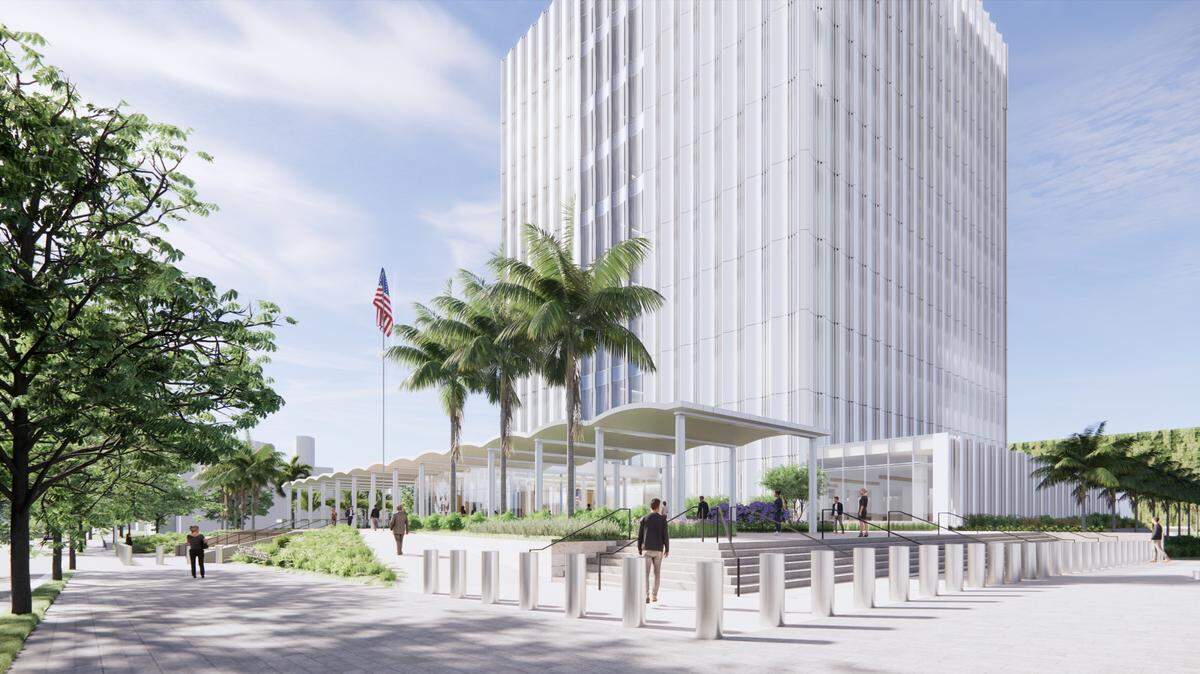
Solving a 20-year quandary, the federal government has unveiled plans for a $190 million U.S. courthouse in Fort Lauderdale that echoes the city’s signature Mid-Century Modern architecture and is expected to drive a wave of redevelopment on the funky south side of the city’s resurgent downtown.
The release of the blueprint, by architectural colossus Skidmore, Owings & Merrill, or SOM, caps a long campaign by Fort Lauderdale’s civic and business leaders to keep a federal courthouse downtown.
The project, the most significant federal investment in South Florida civic architecture since the completion of Miami’s newest U.S. courthouse in 2006, is slated to start rising in 2023 on a site on the Tarpon River acquired by the government last year for $13.5 million.
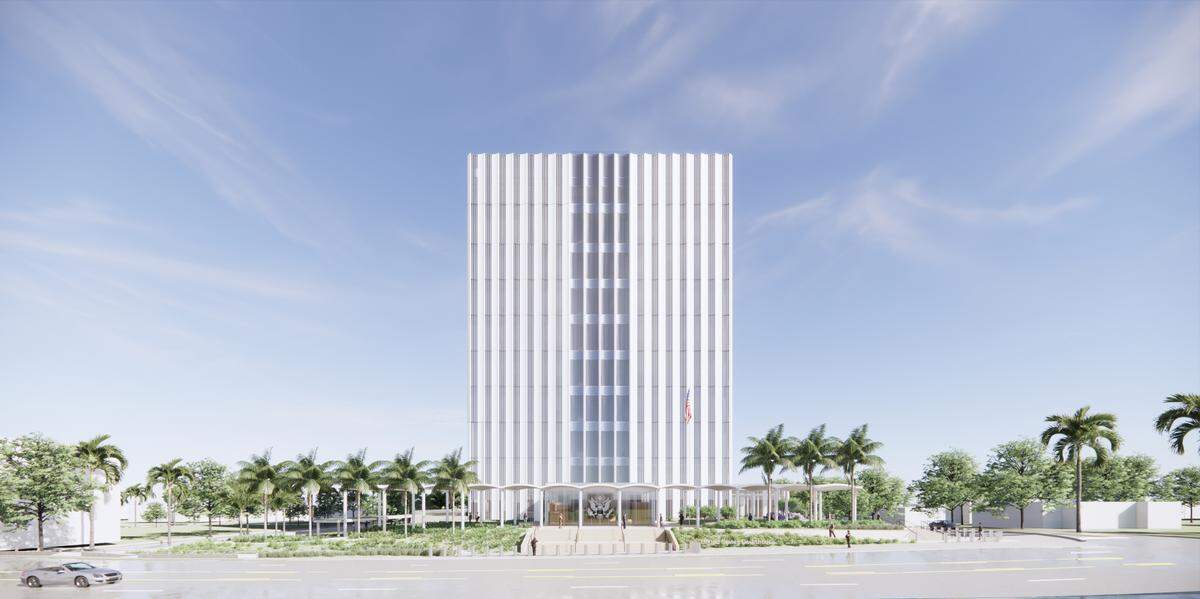
The design features a spare, square white tower with fluted panels of glass and metal that recall the classically inspired federal buildings of the 1960s. In a nod to tropical Modernist design, the 10-story tower is fronted by a wavy, sheltering arcade for pedestrians that extends to the ends of the 3.5-acre lot. At the back, on the riverbank, the plan calls for a new park and promenade and preservation of existing mangroves.
The plan’s release also reopens a long-running debate over the fate of the existing federal courthouse, which sits on Broward Boulevard, nearly two miles north of the new courthouse site. The monumental 1979 building, made of raw concrete with a dramatic open corner and a public courtyard, is widely considered to be one of Florida’s most significant works of modern architecture, but has been plagued for years by gushing leaks and mold.
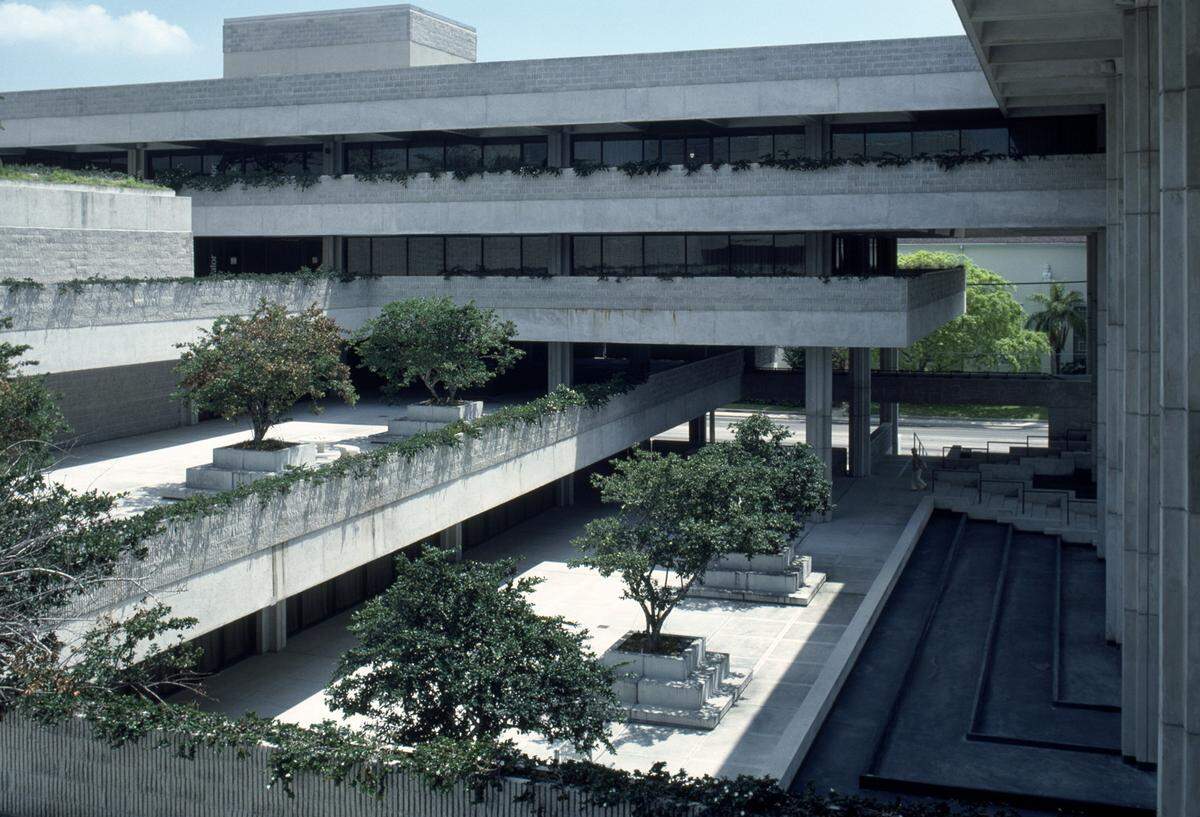
The fresh plan cements a controversial decision by the federal General Services Administration after years of debate to build new instead of renovating the old. The agency concluded the existing building, now undergoing $865,000 in repairs to extend its life until the new courthouse’s planned completion in 2026, would be too costly to modernize, especially because it’s not big enough to handle the Southern District of Florida’s growing caseloads.
Preservationists are now pressing the agency, which has not said what it plans to do with the Broward Boulevard property, to save the building for a new use.
On Tuesday, Fort Lauderdale city commissioners agreed to reach out to the GSA, which manages federal properties, to find out its intentions for the 44-year-old courthouse. The city’s historic preservation board earlier voted 6-0 to ask the city to explore designation as a protected landmark for the courthouse building, designed by the late William Morgan, a leading Florida architect of the Modernist era who took cues from pre-Columbian monuments.
Mayor Dean Trantalis said during a public discussion that the GSA had assured him “a couple of years ago” that if the old courthouse was sold, it would be with the stipulation that the building can’t be torn down. But he didn’t know if that’s still the federal agency’s position.
Commissioner Steven Glassman, a preservationist and former president of the Broward Trust for Historic Preservation, said the building could be converted to other uses by a new owner. He cited a former state office building that Morgan designed in the same Brutalist style of the Fort Lauderdale courthouse in his hometown of Jacksonville that is today part of a riverfront Hyatt Regency Hotel complex. The Brutalist label is derived from a French term for raw concrete.
“Demolishing that building would be tragic for Fort Lauderdale,” Glassman said in an interview, referring to the courthouse. “It’s really our public square. It’s a very significant corner. It’s quite stunning, Brutalism at its finest.”
SOM’s design couldn’t be more of a contrast to Morgan’s.
The Chicago-based firm, founded in the 1930s and a pioneer in Modernist architecture in the United States, is famed for its skyscrapers, including several of the world’s tallest. Among those are the John Hancock Center and the Willis (formerly Sears) Tower, both in Chicago, One World Trade Center and the current record-holder, Burj Khalifa, in Dubai.
The firm is also known for its clean, even minimalist style — and not just in skyscrapers. Other well-known projects range from the chapel at the U.S. Air Force Academy in Colorado to the new Moynihan Train Center in a restored, historic U.S. Post Office building across from New York’s Penn Station.
It’s also no stranger to South Florida. In Miami, the firm designed the landmark downtown Southeast Financial Center tower with its cascading bayfront ziggurat. The company also designed the massive new Miami Central Station, which also includes two residential towers and an office high-rise, for the Brightline passenger train service, as well as its stations in downtown Fort Lauderdale and West Palm Beach.
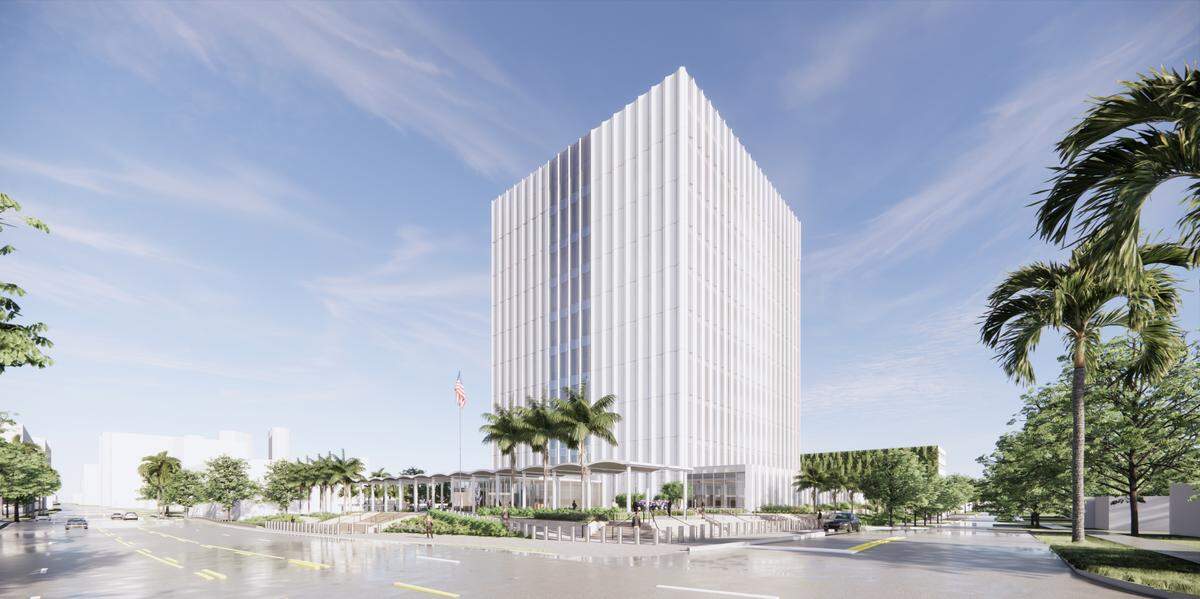
For the new Fort Lauderdale courthouse, the firm’s architects said they aimed not for monumentality, but an efficient and simple, elegant functionality. The tower sits on a slightly elevated platform, to meet flood standards but also to give it the prominence a civic building deserves, said SOM architect Paul Danna, who leads the firm’s Los Angeles office. Broad steps lead up to a formal entrance.
The restrained interiors feature oft-used South Florida materials like terrazzo for flooring, coral stone and oak for furnishings and detailing.
The 252,000-square-foot building will house 12 courtrooms with natural light, 17 judges’ chambers and work space for other federal agencies, including space for visiting judges from the federal appellate court in Atlanta, the U.S. Marshals Service, the U.S. Attorney’s Office and federal probation officers.
Danna and project manager Joseph Ruocco said in an interview they worked to ensure their design harmonizes with its Fort Lauderdale context. Their goal, they said, was to create not just a formal courthouse, but also a welcoming oasis of shade, greenery and river for visitors and Fort Lauderdale residents to enjoy, despite post-9/11 security features like the bollards that encircle it.
“We think the design is smart and appropriate,” Danna said. “We know it will be under intense scrutiny. We think we’ve done very good work there. ... The intent is definitely not to create a fortress.”
In fact, the new project has something in common with the old courthouse by Morgan, part of a concerted effort in the late 1970s to revive downtown Fort Lauderdale’s sagging fortunes by building new government buildings, including the Brutalist-style Broward County Main Library nearby, as well as private office and commercial towers. After a long lag, a surge of new residential and commercial buildings has turned downtown Fort Lauderdale into a humming, expanding urban center.
Business and civic leaders hope the new courthouse will do the same for a stretch of urban Fort Lauderdale south of the New River that’s home to the county jail and courthouse and a jumble of vacant lots and old houses, some converted to offices for lawyers and bail bondsmen. The area is now seeing new, denser residential and commercial development, and the new facility will draw more, said Jenni Morejon, president of the Fort Lauderdale Downtown Development Authority.
“From day one we recognized the importance of keeping this courthouse downtown,” said Morejon, noting her agency has been pushing for it since 2011. “When the government invests in an area, it’s a huge signal to the private sector that it’s there long term. It’s how great cities evolve, where major catalytic projects come in and chart the course for how a district evolves.”
Preservationists, meanwhile, hope that rapidly developing downtown Fort Lauderdale will hold a place for Morgan’s courthouse, which Florida’s Division of Historical Resources has named one of the top 50 “flagship” modern buildings in the state deserving of protection.
“This is arguably one of his more significant works,” said Morris “Marty” Hylton III, a former head of the University of Florida’s historic preservation program. In 2018, he organized a well-attended workshop on the Morgan courthouse to devise ways of adapting and reusing the building.
“It’s about what you value more — culture and heritage, or economics,” he said. “The idea that you’re going to build anything on that site of the quality of this building is simply false.”
This story was originally published February 2, 2022 at 6:00 AM with the headline "Fort Lauderdale getting a $190M U.S. courthouse, while efforts mount to save the old one."