
Taxpayers are spending millions to host Super Bowl 54. What are they getting in return?
If you want to know how Miami-area residents may benefit from hosting Super Bowl 54, a mega-event for which area residents are paying millions yet which few are likely to attend, look no further than Captain Fish & Chicken in Miami Gardens.
There, owner Sam Saleh says he is already seeing a surge in orders from local residents for game-day take-out orders, including one for 300 wings. It’s the kind of foot traffic the restaurant usually sees only on Christmas Eve and New Year’s.
Or one could look to Max Diaz, a local bartender who says he expects to earn at least $500 a night for staffing the week-long party at Miami Beach’s Cameo nightclub.
For the next two weeks, South Florida will be an even more intense entertainment mecca than it usually is, and there would seem to be plenty of opportunities for businesses to take advantage of the Feb. 2 match-up. Although Miami’s Super Bowl host committee has not released an official economic-impact estimate, if last year’s game in Atlanta is any indication, the estimate could come in north of $500 million.
But the game is coming at a cost, measuring at least eight figures, to taxpayers. Which may leave many of them asking: What’s in it for me?
Paper Cost
For Miami-Dade taxpayers, the baseline bill, according to a Herald analysis, is as much as $20 million over time. That includes $10 million spent by the county for area-wide preparations like police, paramedics and infrastructure, as well as an initiative in partnership with the National Football League to upgrade area youth playing fields with artificial turf.
It also includes $4 million the county is paying directly to the Miami Dolphins as part of a bonus agreement negotiated with team ownership as a reward for landing the big game.
The Miami Super Bowl host committee is also raising funds from public and private entities.
Then there are unseen state and local subsidies. For example: All game tickets sold are tax exempt, thanks to a state law adopted in 2010. And Miami Gardens will also be providing beefed-up emergency services for which it will not be directly reimbursed.
Miami-Dade declined to disclose what is referred to as its “bid book,” which lays out the exact spending and staffing requirements demanded by the National Football League in exchange for hosting the game. But in the run-up to the 2018 Super Bowl hosted in Minnesota, a bid book dated to 2014 was published by the Minneapolis Star Tribune. In it, the Minnesota Department of Revenue calculated that the tax break on Super Bowl-related tickets and parking receipts cost the state $9 million, and local governments $1.3 million, in potential revenue, the paper reported. And Minneapolis’ Super Bowl Host Committee was told to reimburse the National Football League for some taxes that were not exempted, like player income taxes, the Star Tribune said.
And according to Victor Matheson, a sports economist at the College of the Holy Cross in Massachusetts, the phrase “at no cost to the NFL” appeared numerous times.
R.T. Rybak, the former Minneapolis mayor who helped the city land the Super Bowl, said in an interview that he remains “disgusted by the games the NFL plays that pits cities against one another” as they bid for the event. Yet he cannot imagine a scenario where cities will ever band together to push back against the league. And, he admits, the game did seem to provide a significant economic boost to the Twin Cities region, which does not usually see much tourism in the dead of winter.
The NFL did not respond to requests for comment.
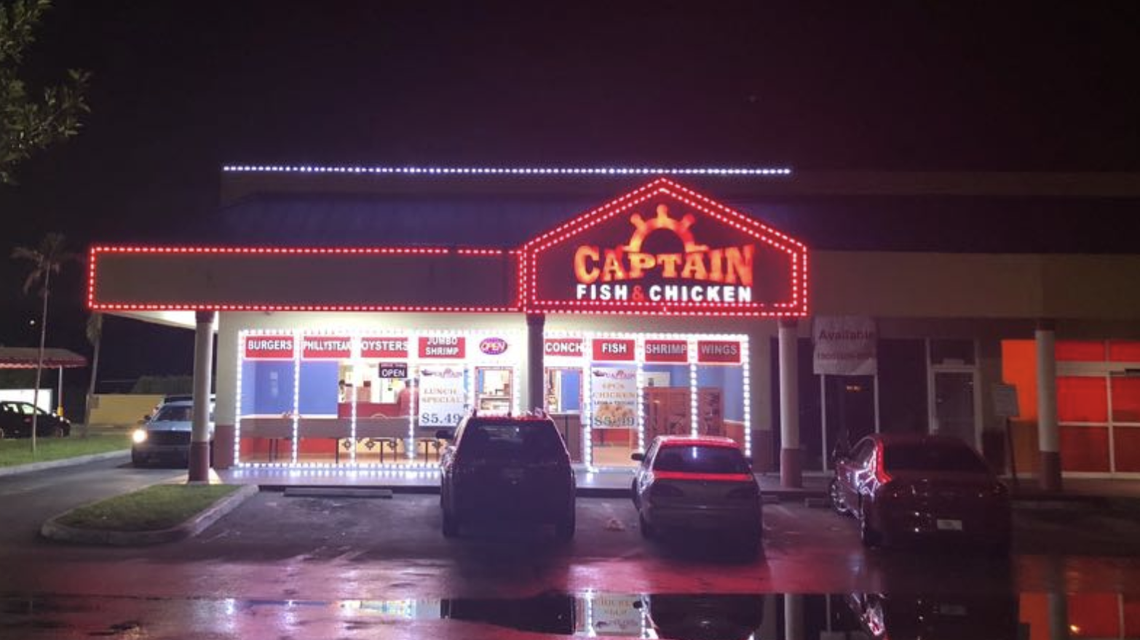
Of course, winter is not usually a problem for Miami. And for Andre Williams, head of the recently established Miami Gardens Chamber of Commerce, it’s the host city and its residents who may end up paying the highest price. Restaurants like Captain Fish do not necessarily reflect the experience of many other Miami Gardens establishments, Williams says.
“For the little mom and pop businesses here — they’re not going to benefit,” he said. “We see that after Dolphins games: People come here and get the hell out. We don’t see a lot of commerce passing hands.”
The lack of spending by Super Bowl-goers is likely to be even more acute, he says, given the expected demographic profile of a typical big-game attendee.
“The type of people the game attracts — these are high-moneyed folks, and they’re more likely to spend their money in Broward or Miami Beach, where they’re hosting most of the high-profile events.”
In Williams’ view, there could be many more businesses like Captain Fish that could be benefiting from having the Super Bowl a few blocks away. Given the city’s large Caribbean population, Williams imagines creating a Caribbean-themed street fair that could draw game attendees and hangers-on.
Economists’ View
Many academics would side with Williams’ argument that the expected costs of events like the Super Bowl are larger, and the gains smaller, than are typically forecast.
Among the most outspoken skeptics of the benefits of hosting large events is Matheson, the Holy Cross economist. His research has yielded a rule of thumb about the expected-impact statements put out by local organizers: Reduce it to a quarter, or even a tenth, of what they predict. The reason is threefold:
First, whatever economic activity occurs during the Super Bowl may be crowding out run-of-the-mill activity that would otherwise be occurring in South Florida. And while one might think Super Bowl-related spending may be greater than that run-of-the-mill spending, it is in no way true across the board, Matheson says.
The second issue is leakage: While hotels are marking up the cost of rooms to astronomical levels, many of the funds spent there will not flow to local stakeholders but rather out-of-town owners of the rooms. Matheson calls this a “leakage” effect.
“Expensive hotels may be increasing the price of rooms by a factor of three or four — but they’re not necessarily increasing wages for desk clerks,” he says.
On the hotel front, Frank Stephenson, an economist at Berry College in Georgia, has found wide variations in the number of marginal hotel rooms booked by a given host city for major events. Along with co-author Lauren Heller, Stephenson calculated that while Minneapolis-St. Paul — not exactly must-see winter destinations — saw more than 63,000 extra rooms booked thanks to hosting the 2018 game. Balmy Phoenix, on the other hand, added fewer than 36,000.
Here, the glowing impact estimates issued from some corners fail to mention that the gains are marginal, because in many cases Super Bowl visitors are crowding out regular visitors; hotel occupancy during winter months in the Miami area is already substantial.
“The difference is key,” he said. “Because that’s the real gain.”
Or as Matheson puts it, “It’s easy to see the economic activity that does occur. The problem is, it’s hard to see the activity that does not occur.”
Benefits
Neither Matheson nor Stephenson would go as far as to say that there is zero benefit to hosting the Super Bowl.
But from other quarters, there is evidence that the loftier projected gains may in fact be close to reality.
According to travel research group STR, room counts in South Florida have grown by about 10,000 since 2010, the year the region last hosted the Super Bowl.
More importantly, most economists agree the U.S. economy will continue to see healthy growth — meaning visitors will be in a spending mood.
As a result, STR estimates that the typical daily hotel room rate in the Miami market could reach more than $500 for the weekend of Jan. 31-Feb. 2. If that happens, this year’s Super Bowl will be the most expensive in recent history for hotel guests. Additional reporting from Bloomberg shows local luxury rental hosts charging $5,500 a night for a one-bedroom condo at the 1 Hotel South Beach, or $40,000 for a four-bedroom penthouse.
According to the Herald’s own analysis, hotel room rates for the weekend of the big game are running about 1.5 times higher than on the following weekend.
“In 2020, Miami will be starting from a higher basis because of the already high rates in the market,” STR said.
Mike Palma, executive vice president of Miami Beach-based BRIO Investment Group, which owns The Clevelander Hotel, says Super Bowl weekend represents an unprecedented marketing opportunity not only for The Clevelander, but for all of South Florida itself, though Miami Beach will see an outsized gain, he says, because it serves as the focal point for many of the game’s related attractions, like the Super Bowl Experience.
“[The Super Bowl] is an international event now,” he said. “You can’t buy that kind of exposure.”
Palma says The Clevelander has been able to charge double the rates it usually charges this period. It is also hosting a Pepsi-sponsored event that will feature Snoop Dogg, Fat Joe, Lil’ Jon, and others. He also expects guest revelers to spend outsized amounts on hotel food and drink.
“You’re going to see a lot more AmEx cards,” he said.
Meanwhile, a temporary luxury Super Yacht Village is planned at the site of the Miami Boat Show at One Herald Plaza, for which organizers are paying for permits and fees that would otherwise not exist during the week of the game, according to event co-organizer and spokesman Eric Levin.
And private jet charter group Wheels Up expect to see a 50% boost in traffic compared to previous Super Bowls. The expected increase in air traffic should have a positive impact on local businesses and will generate additional airport slot fees for Miami-Dade County airports.
“This is the Woodstock of corporate America,” said Wheels Up CEO Kenny Dichter.
For Super Bowl host committee Chairman Rodney Barreto, there are now simply more opportunities, from hotels to restaurants to Uber, to spend money across South Florida than there were the last time the game was hosted here. The increased spending will flow back to taxpayers in the form of higher sales-tax receipts, he said.
“It’s a great investment for your community — the government knows it, elected officials know it,” he said. “Having all these people come in and travel ... sure, the stadium only hosts 65,000, but you’re going to have 200,000 people traveling to the region. Yeah it’s unfortunate, they do outpace the little guy, but it’s corporate America at its best.”
Catering Locals
If big businesses are finding ways to benefit, so are smaller ones. Bill Hansen, a longtime local caterer, will be manning the Super Bowl Host Committee’s official receptions at the Miami Tower’s Sky Lobby. For Hansen, there is a “displacement effect” of customers putting off spending — but not in the way one might imagine. One of Hansen’s primary business lines is weddings — and it is not as if couples are foregoing tying the knot entirely.
“Some of our couples have shied away from getting married that weekend — but they’re just moving the date to alternate weekends,” he said.
Overall, he said he expects to do between three and four times the dollar-amount business he would otherwise do around this time.
Then there’s Flanigan’s. While the stalwart South Florida watering hole is not expecting much foot traffic on game day — ”Everyone has a 70-inch television,” Jimmy Flanigan said in an email — there will be benefits to having the game nearby. Flanigan said his restaurants will sell “a tremendous amount of to-go food … particularly chicken wings,” he said. In a typical week, Flanigan’s will sell 1,000 cases of chicken wings. During the week of the big game, he expects that figure to reach 1,700 — or about 68,000 pounds, equating to 268,000 chicken wings.
“That’s a lot of damn chickens,” he added.
Other beneficiaries include Cameo nightclub. Owner Zori Hayon expects his club will see three times the usual business on a February night. The club plans to host a party featuring Diddy and Rick Ross among others.
And thanks to that party, Max Diaz, a local bartender, will be picking up extra work. Diaz says Cameo is paying him $500 a night, plus 20% of service, to work as a busser.
“It’s going to be the biggest event I’ve worked at,” he said.
This story was originally published January 22, 2020 at 6:00 AM with the headline "Taxpayers are spending millions to host Super Bowl 54. What are they getting in return?."
