
House members question how new Cuba policy will improve human rights
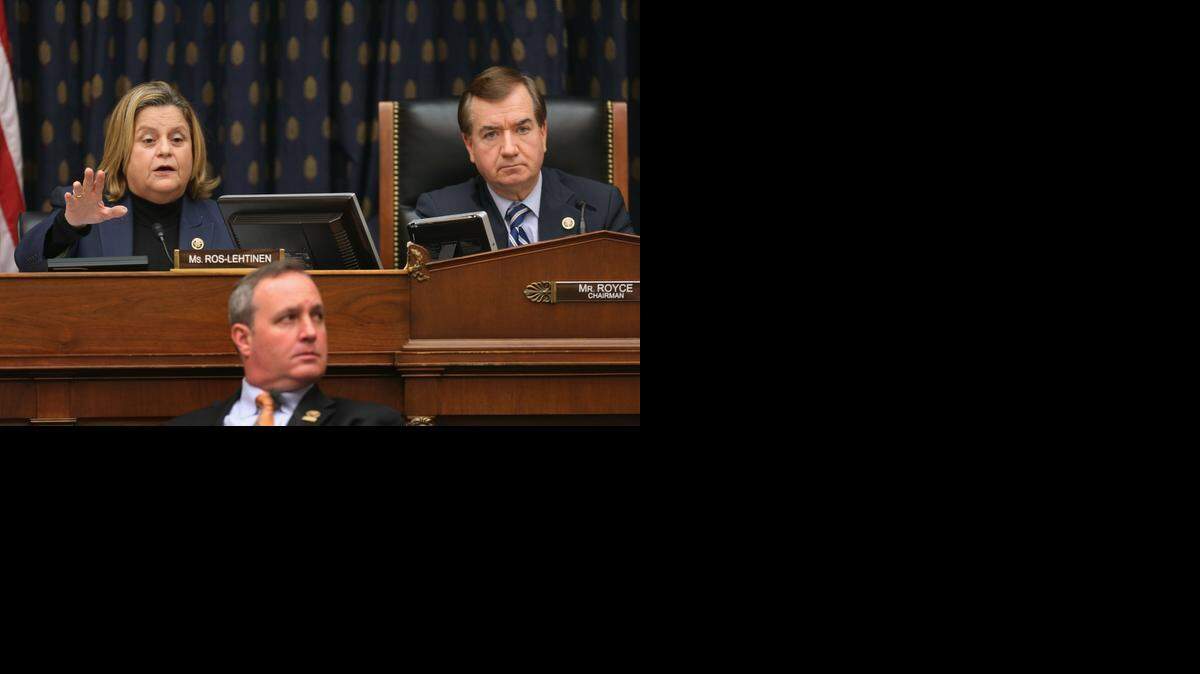
In an at-times combative hearing, the U.S. House Foreign Affairs Committee on Wednesday questioned whether the United States’ new relationship with Cuba would improve Cuba’s human rights record.
During the hearing on the Obama administration’s “sudden shift” in Cuba policy, Committee Chairman Ed Royce, a Republican from California, said, “This could have been used to leverage meaningful concessions on human rights in Cuba.”
Other members of the committee, including some who favor the new Cuba policy, also pressed Assistant Secretary of State for Western Hemisphere Affairs Roberta Jacobson on what the United States was doing to get Cuba to respect human rights.
Rep. Eliot Engel, a New York Democrat, noted that last year the Cuban Commission for Human Rights and National Reconciliation, an independent organization, reported 8,899 short-term detentions on the island. That was a 39 percent increase over 2013.
In recent years, there has been a shift in Cuba from long-term detentions to many short-term detentions. But Jacobson said the strategy of short-term detentions is also “an enormous concern to us.”
In January, she said there was a drop in short-term detentions. But at this point, she said, it’s “not a trend. I want to be clear about that.”
In testimony before a Senate subcommittee Tuesday, Tom Malinowski, the State Department’s senior human rights official, said short-term detentions in Cuba fell from 489 in December to 178 in January. Through 2014, he said, the monthly average was 741 short-term detentions.
“It must end, not just come down,” Jacobson said.
But she said the policy shift has already had a positive impact on U.S. work on human rights.
Jacobson said that the old policy of isolating Cuba had become “such an irritant” to Latin American countries and European allies that some countries were wary of working with the United States on trying to improve human rights in Cuba because they didn’t want to “appear aligned with our previous policy.”
Rep. David Cicilline, a Democrat from Rhode Island, said he remained “deeply concerned about Cuba’s long record of human rights abuses” and asked Jacobson what was the best way to engage the United States’ regional partners.
“Many of them were hesitant, if not outright refused, to engage with many of the democracy activists for years,” said Jacobson. “These people (activists) are often accused of being our tools.”
Now, she said, she is “very optimistic” that U.S. allies have “lost that fear with our change in policy.”
“They think it changes the whole dynamic on other issues we have in the hemisphere,” Jacobson said. “They feel strongly the policy of isolating Cuba was not the right one.”
A rules change at the Summit of the Americas, which takes place in Panama in April, means that for the first time Cuban dissidents and independent organizations may be invited to take part in the parallel civil society forum, Jacobson said.
New York Democratic Rep. Gregory Meeks, among those who favor the new policy, said his interest was “a better day for the Cuban people.” He asked Jacobson what the reaction to the shift was within Cuban civil society.
“I was struck by the diversity of views — some supportive and some obviously very strongly opposed. We continue to support all of them,” said Jacobson, who was in Havana last month as the chief U.S. negotiator in normalization talks with Cuba.
The House Subcommittee on Global Human Rights will hear from Cuban dissidents Thursday during a hearing entitled “Human Rights in Cuba: A Squandered Opportunity.”
Asked repeatedly whether the United States should have received more concessions from the Cuban government after ditching its 50-year-old policy, Jacobson responded: “We believe on balance the Cuban people will benefit more from this than the Cuban government.”
She said that the United States wasn’t giving Cuba a gift, but opening a “channel of communication” that would allow it to take up divisive issues, such as human rights and the return of U.S. fugitives from Cuba.
Jacobson said Cuba has accepted the idea of having a separate conversation on law enforcement and fugitives. “We will try to set those [talks] up as quickly as possible,” she said.
But New Jersey Rep. Albio Sires, a Democrat who represents the second-largest Cuban-American community in the United States, said he wasn’t convinced. “I don’t see what we negotiated will lead into anything,” he said, or would apply the leverage that would result in “economic progress for the Cuban people.”
“Indeed, Castro is making even more demands,” Royce said.
Not only has Cuban leader Raúl Castro said that the embargo must be lifted before there can be normalization of relations between Cuba and the United States, but he also wants the return of the U.S. base at Guantánamo, compensation for damage caused by the embargo, and an end to Radio and TV Martí.
“The issue of Guantánamo is not on the table in these conversations,” responded Jacobson. “We have no plans to end those, either,” she said of the Martí broadcasts.
“What the Cubans meant by normalization is the end of a years-long process,” Jacobson said. Reestablishing diplomatic relations with Cuba, which is now under way, is just the first step, she said.
Committee Chairman Emeritus Ileana Ros-Lehtinen, a Republican from South Florida, also took umbrage with the secret negotiations the U.S. conducted over 18 months while “keeping Congress, the American people, even our own diplomats in the dark.”
The most emotional exchange came when Ros-Lehtinen queried Jacobson about the return to Cuba of spy Gerardo Hernández, who was convicted of espionage charges and conspiracy to commit murder in connection with the deaths of four Brothers to the Rescue pilots whose planes were shot down by Cuban MiGs as they neared Cuban territory in February 1996.
Three convicted spies, including Hernández, were returned to Cuba in exchange for Cuba’s release of a jailed CIA agent. Cuba also released USAID subcontractor Alan Gross, paving the way for the breakthrough that resulted in Cuba and the United States announcing they had begun the process of restoring diplomatic ties.
Ros-Lehtinen posed a question given to her by the family of Armando Alejandre Jr., one of the pilots who was shot down.
She asked how Marelene Alejandre Triana, Alejandre’s daughter, could explain to her daughters why their grandfather’s life “meant nothing” and the person convicted as a co-conspirator in his death “was pardoned, set free, and returned to Cuba and received a hero’s welcome?”
Jacobson responded: “Let me start by saying I can never bring back her grandfather, and I can never do more than express my sadness and my condolences to her.”
Ros-Lehtinen: “She was told by you and others that a trade would not take place. This is a swap, is it not?”
Jacobson: “Madam Chair, I just want to say an exchange of intelligence agents between two countries is something this government and previous administrations have done many times.”
Technically, the U.S. has said that the three Cuban spies were exchanged for the CIA agent, and the Cubans released Gross as a humanitarian gesture.
Ros-Lehtinen: “But hadn’t the State Department met with the family? And didn’t the State Department time and time again tell her that Gerardo Hernández would not be set free by this administration, yes or no?
Jacobson: “That a swap for Alan Gross would not take place, we affirmed and we did not do.”
Ros-Lehtinen: “You just called it something else…”
Jacobson: “I regret if the family felt additional pain because of an impression that…”
Ros-Lehtinen: “An impression? So that’s all they had, they had a false impression … while all this time you were meeting with them, you were already cooking up this swap, whatever you call it? Don’t you at least feel a little bit bad that you were lying to them?”
Jacobson: “No one who met with the family ever lied to the family about what our understanding…”
At that point, Ros-Lehtinen cut her off, saying that she would enjoy hearing the family’s reaction to her testimony. “Just pathetic,” she added.
This story was originally published February 4, 2015 at 3:22 PM.