
Rumors abound about Fidel’s future burial site
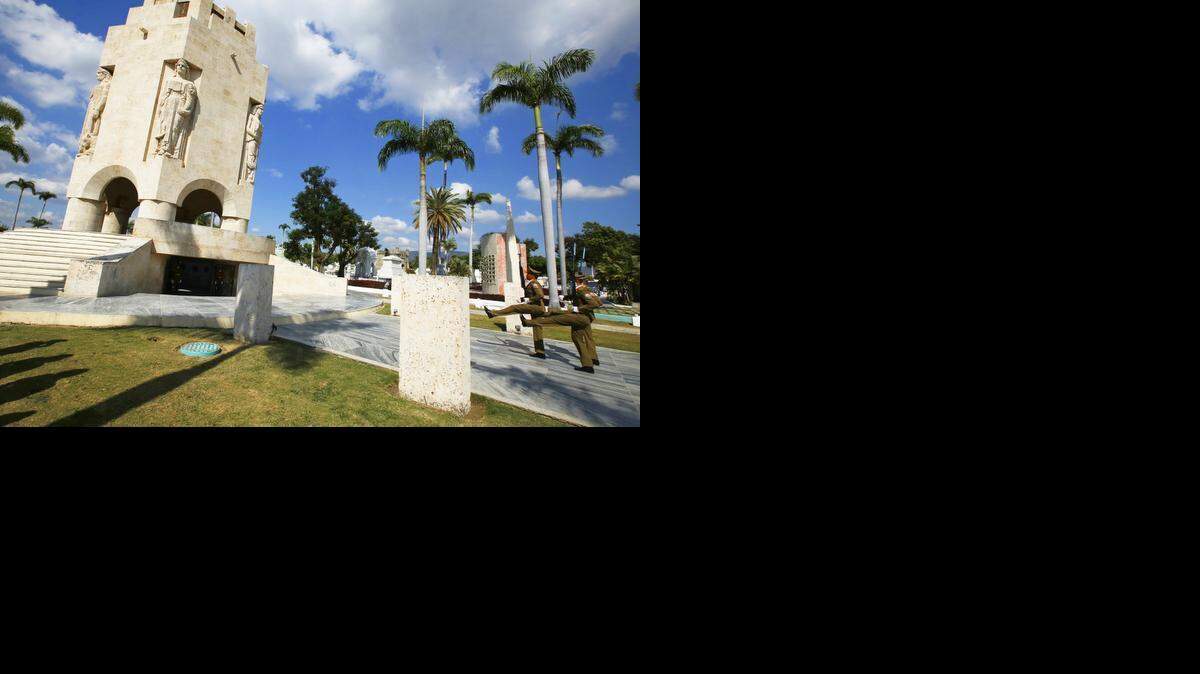
In the city that claims to be the cradle of several revolutions, beneath an unforgiving sun, rests José Martí, the Cuban national hero who asked to “die facing the sun.”
And it is here in the St. Ifigenia cemetery, close to Martí’s mausoleum, where Fidel Castro’s tomb may finally be located.
The remodeling work at the cemetery and its surroundings has fueled rumors about the former president’s health and the place of his grave. Selecting St. Ifigenia, where the remains of a myriad of Cuban patriots lie, and the city of Santiago de Cuba, would give the Cuban government the symbols for a grand gesture to forever inscribe the comandante in the history of Cuba.
The remodeling project involves everything from the cemetery’s landscaping to rebuilding the highway that links the graveyard to the iconic Plaza de la Revolución in Santiago de Cuba, home to the monument of independence war hero Antonio Maceo.
“All this area is being repaired because here [in St. Ifigenia] will rest the remains of Fidel,” said a cemetery employee. “But all that is still a secret.”
The rumors are nothing new. Since the 1980s, there have been reports that Castro was on the brink of dying of a heart attack, cancer, and even a brain hemorrhage.
But in 2006, Castro underwent emergency stomach surgery that forced him to surrender power to his younger brother Raúl, at first temporarily and then officially in 2008.
In January 2012, the website of the Miami organization Cuba Independiente y Democrática reported that Castro’s tomb had been built in St. Ifigenia under “an arc covered by pink marble.”
No official confirmation
Yet no news outlet confirmed the construction in the cemetery area until this January, when el Nuevo Herald reporters visited Santiago de Cuba. Even so, there is no official confirmation that this will be Castro’s final grave. The Cuban Interests Section in Washington did not respond to calls from El Nuevo Herald on Friday.
There are no evident signs at the cemetery of a specific site for Castro’s tomb, but guards block access to a broad area next to Martí’s mausoleum.
Several feet from the cemetery, reporters observed a dozen gardeners were planting purple bougainvilleas and palm trees brought in trucks. In front of this place, across a stream, is the start of a roadway that connects to the Antonio Maceo Revolution Square. The road has been closed due to major reconstruction work.
The first segment, which extends from the cemetery to the Yarayó Fort and is nearly half a mile long, is completely closed. Along this unpaved stretch, named in honor of Flor Crombet, a general in the Cuban War of Independence, circles of stones block access to vehicles.
“All this has been closed for about a month and a half because they are fixing it. ... It is said that when Fidel dies, his remains will be brought to Santa Ifigenia,” said Jorge, a bicycle-taxi driver who serves tourists in the area.
“There is a lot of love and respect for Fidel, especially here, because he is from Santiago,” he said, though Castro was actually born in the town of Birán, in the province of Holguín. He did, however, attend school in Santiago when he was a child.
The second phase of roadway construction, from Yarayó Fort to the Plaza de la Revolución, shows work in full progress. This stretch of the road is named after another Cuban independence war hero, Juan Gualberto Gómez, though it’s popularly known as Patria Avenue.
Lots of construction
Here, construction workers have already remodeled the first three blocks, between Los Libertadores Avenue, close to the Plaza de la Revolución, and Patricio Lumumba Avenue. Visible are recently paved roadways with lane dividers to organize traffic. New gardens have also been planted and a mural has been erected with a sign saying: “Above all, the homeland.”
Workers continue repairing eight blocks between Lumumba and Mariana Grajales Avenue. Every day, from about 7 a.m. to 6 p.m., mechanical shovels, excavators and trucks operate in this area to install a rainwater collecting system that will cover the entire avenue.
Several houses along the avenue show remodeled facades, with aluminum doors and windows provided by local governement authorities, the residents said.
“They gave us the doors and windows last year, so that our houses could be prettier,” said Manuel, who lives in a two-story house on Gómez Avenue. “Little by little they are fixing this road that leads to the cemetery.”
The work has moved forward amid speculation from the media about Castro’s alleged death. Early last month, rumors circulated worldwide on social media and among foreign journalists that a press conference was to be held to discuss Castro’s health.
Responding to rumors
Gradually, the Cuban government began to respond to the rumors.
First was Argentine soccer legend Diego Maradona’s public appearance to express his joy at learning that Castro was in good health after he received a letter from Castro congratulating him for his television show De Zurda,” which airs on Venezuela-based Telesur network.
Then, on Jan. 22, Castro was honored by the National Organization of Collective Law Offices, which granted him the Honor Gown of Cuban Lawyers, though the recognition was accepted on Castro’s behalf by the second secretary of the Council of State, José Ramón Machado Ventura.
Four days later, on Jan. 26, a letter, reportedly written by Castro, was published by the Cuban government. In the letter, Castro opined on the decision by his brother to normalize relations with the United States. On Jan. 29, the Cuban official newspaper Granma then published a statement by the Brazilian theologist Frei Betto, who said that Castro was upbeat and in good health.
None of these documents or statements was accompanied by photos of the 88-year-old Castro, whose last public appearance was Jan. 8, 2014, when he turned up at the opening of a Havana gallery and art studio.
Unlike Fidel, his brother Raúl has publicly announced his final resting place — next to the grave of his late wife Vilma Espín at the mausoleum of “el Segundo Frente” in the surrounding mountains of Santiago de Cuba, where both fought in the ’50s.
There, workers routinely keep the cemetery in good condition, taking care of the green areas and placing flowers in memory of Vilma. There is no sign of any new construction, and only Raúl Castro’s name is engraved next to the name of his late wife on the monument.
About 400 miles away in Santa Clara, home to the mausoleum of iconic revolutionary leader Ernesto “Che” Guevara workers are erecting two buildings to house security guards who protect the mausoleum. It is a popular tourist attraction.
A few feet from the mausoleum, there is a big sign with the smiling face of Hugo Chávez, the late Venezuelan president. It reads: “Chávez, our best friend.”
Editor’s note: The stories of this series do not carry bylines, and photos do not show credits because the Cuban government refused to grant visas to reporters from el Nuevo Herald. Also, some of the people quoted are only identified by their first name to avoid retaliation from the authorities.
This story was originally published January 31, 2015 at 10:45 PM.