
Fruit fly outbreak triggers South Miami-Dade quarantine
An outbreak of an aggressive Asian fruit fly — believed to be the largest so far in the state — has triggered a quarantine of about 85 square miles of fertile farmlands in South Miami-Dade.
The Oriental fruit fly, blamed for heavy damage to mangoes in the Philippines and citrus in Japan, was first detected late last month when a single male turned up in a trap in a tropical almond tree east of the Redland on Southwest 72nd Court. Within two weeks, another fly popped up more than 13 miles away, followed by an even more alarming catch: 45 in a single trap.
While the fly has been detected — and contained — about 10 times since it first appeared in Florida in 1964, numbers never amounted to more than a dozen or so at a time.
As of Tuesday, 116 flies had been caught in an area that houses some of the region’s largest packing houses, threatening a farming industry that sells more than $700 million in crops annually.
“That gets everyone’s attention very quickly,” said Miami-Dade County Agricultural Manager Chalres LePradd. “They’ve also found larvae and that is a significant find.”
The Florida Department of Agriculture and Consumer Affairs is working “around the clock” to contain the flies, said spokeswoman Jennifer Meale. Growers in a quarantine zone that stretches roughly from Southwest 104th to 272nd streets and from 147th and 237th avenues are being asked not to ship or move any fruits or plants until they consult with officials.
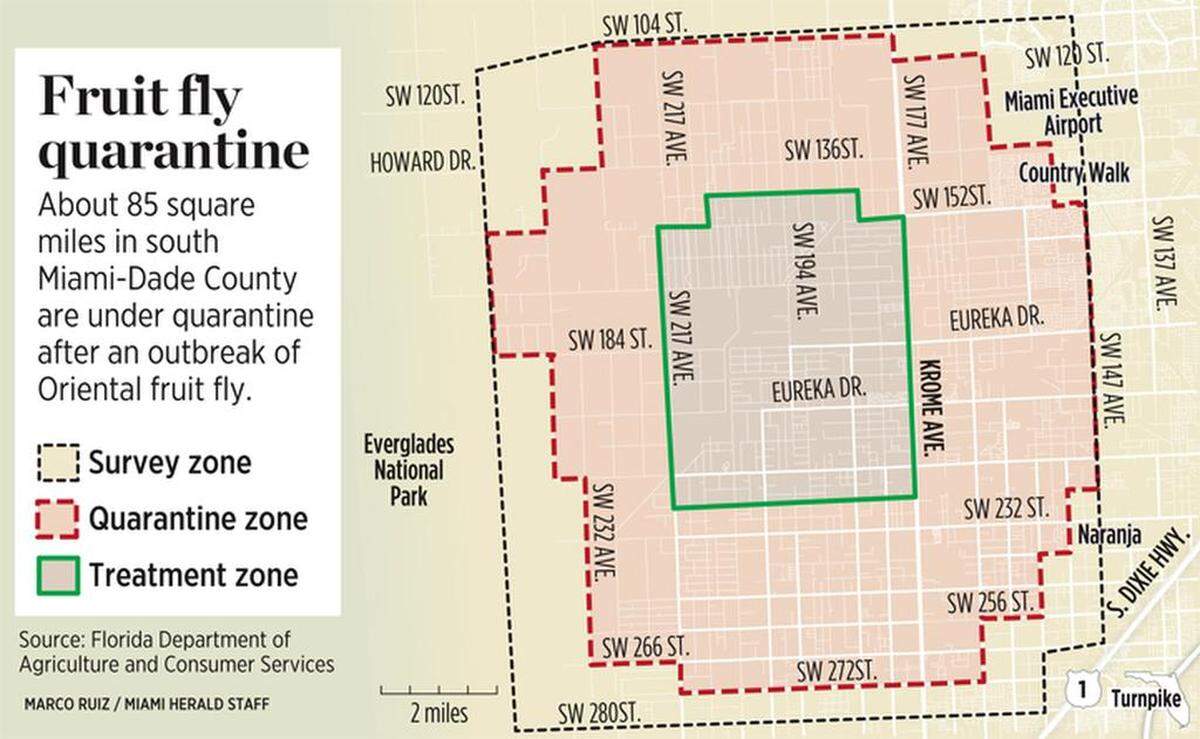
More traps — a gel laced with a female pheromone and insecticide and applied to the tops of utility poles, trees and fence posts — are being set out to target a smaller area where the flies are concentrated.
State Agriculture Commissioner Adam Putnam plans to address the outbreak at a previously scheduled news conference Wednesday. Miami-Dade County and the University of Florida also will have a meeting for growers at 2 p.m. in the county’s extension office in Homestead.
The numbers caught so far raise concerns because the fly has a wide range of hosts that include about 95 percent of the fruits and vegetables grown in the county.
“When you have something specific, you can do something targeted to control it. But this one could almost attack any plant. Not only fruits, but vegetables and a bunch of plants,” said University of Florida entomologist Daniel Carrillo.
State officials do not yet know how the fly arrived, but Carrillo said it likely caught a ride with a traveler or plant smuggler. The fly spread from Asia in the 1940s and by 1945 had become a permanent resident of Hawaii. California has had four major infestations between 1960 and 1997, UF researchers say, but only three in recent years.
Florida has fared better due to an aggressive monitoring program that includes about 56,000 traps statewide that so far have detected flies early enough to contain them.
To target the flies, the state is planning to increase the number of traps around the Redland. Each time a fly is caught, a quarantine will be set up covering a 1.5-mile radius that will be monitored for 90 days, or three life cycles. Because the flies have such a short life cycle, they can spread quickly, leaving potentially thousands of larvae in soil around affected plants.
If larva are found, Carrillo said soil could be drenched with insecticide. Trees and plants can also be sprayed, but Meale said the state so far has no plans to spray and believes traps will succeed.
The appearance of the fly comes at a crucial time for growers: in the middle of avocado season and as farmers start planning winter crops, which can cost $3,000 to $12,000 an acre to plant.
“It’s a pricey ... investment as you’re staring down the barrel of a quarantine that could be longer or could be shorter,” LePradd said. “I have full faith in the [control measures] but there can still be unknowns and that is a hard decision for folks moving forward.”
Growers also worry about what happens if traps don’t work.
“What’s phase two going to be? Hopefully it won’t be spraying because that affects a lot of things,” said Gloria Balboa, who raises avocados and honeybees. “Hopefully they’ll let us know enough ahead of time because if we don’t put our hives in lock-down, the hives are going to drop in a heartbeat. So hopefully there’s a lot of gel in those traps.”
This story was originally published September 8, 2015 at 8:04 PM with the headline "Fruit fly outbreak triggers South Miami-Dade quarantine."