
Annual high tide in Miami Beach offers scientists glimpse into future
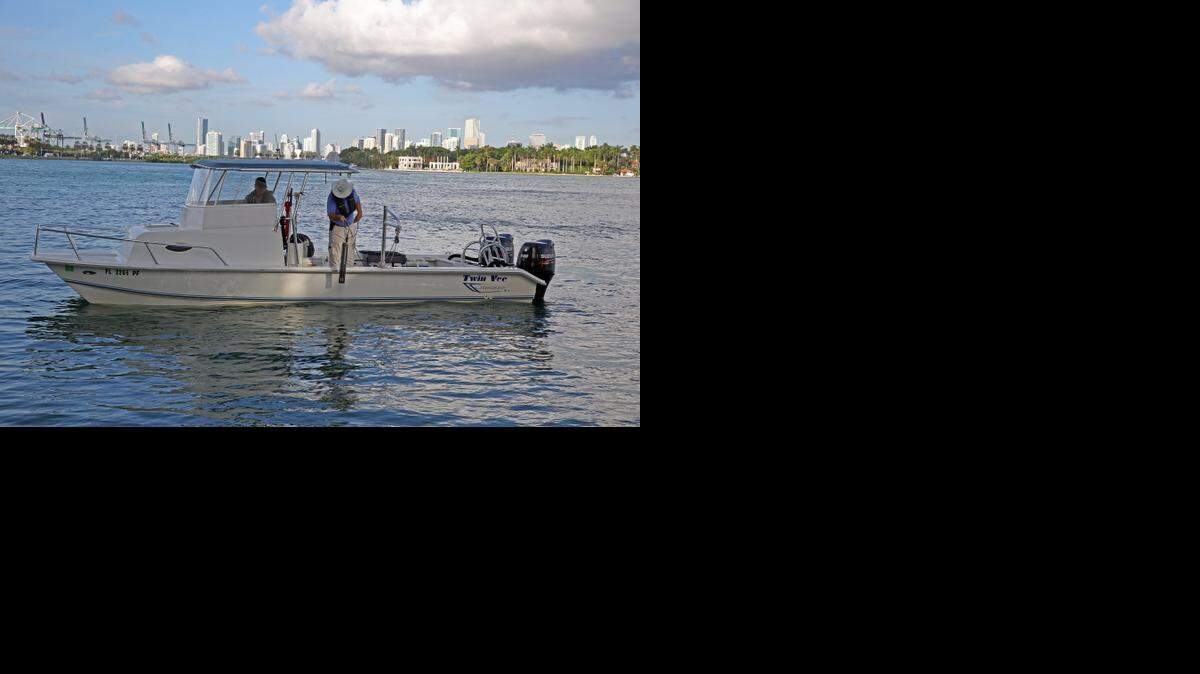
As a seasonal high tide peaked Thursday with Miami Beach’s new pumps successfully keeping the city mostly dry, teams of scientists and researchers fanned out across the island to tackle another side of the sea rise quandary:
Where’s all that pumped-out water going and what’s it doing to us and our ecosystem?
“With rising sea levels, we’re going to have these problems permanently,” said Henry O. Briceño, a Florida International University geologist who orchestrated the research project for the school’s Southeast Environmental Research Center (SERC).
Calling it an “island-sized experiment,” Briceño recruited a half dozen researchers — including a microbiologist and an expert on public health to — look at the consequences of so much pumping, which could reach far beyond Miami as more coastal cities wrestle with sea-rise flooding.
The city has planned for about four dozen more pumps over the next three years to collect and filter storm water before pumping it into the bay. Seas are expected to rise up to four feet over the next century. And with Miami Beach’s streets now flooding with a three foot tide, that means dumping water into the bay will likely become more routine. So Briceño proposed looking at the flip side of rising seas: what happens when the water gets pumped back out?
“The big question is how these high tides are impacting the water quality in the bay,” said Jeff Absten, the project’s field coordinator. “We’re probably going to see degraded water in the bay because they’re not pumping out clean water, for sure.”
The flooding, which helped shine a light on South Florida’s precarious position amid rising seas, has become an annual event to showcase climate change. On Thursday, as the head of the U.S. Environmental Protection Agency led a press conference — including Sens. Bill Nelson, D-Florida, and Sheldon Whitehouse, D-Rhode Island, — to discuss the administration’s efforts, about 120 journalism students from FIU and Mast @ FIU covered the event, using their own sensors to test for salinity in what water remained puddling on the streets.
Last week, Miami Beach also hosted the region’s annual climate conference. Among the public infrastructure projects highlighted were the city’s two new $15 million pumps.
But some scientists worry in the rush to shore up coasts, planners are leaving the environment out of the equation.
“You have this built environment that they’re focusing on protecting, and you can understand that,” said Chris Sinigalliano, a microbiologist with the National Oceanic and Atmospheric Administration who joined the research project to investigate microbes in the water. “If your sole goal was to keep the city from flooding, you accomplished that. But I’m not sure that would be the only goal.”
Funding for water testing has also shrunk. About five years ago when its own budget was cut, the South Florida Water Management District stopped paying to monitor bays throughout the region.
“Once upon a time, we [monitored water] from Sanibel all the way around to the Dry Tortugas and up the East Coast,” said Pete Lorenzo, who manages SERC’s nutrient analysis lab at FIU.
On Thursday, EPA administrator Gina McCarthy said the EPA would work with cities to look at the effects of large-scale pumping on nearby ecosystems, like Biscayne Bay.
“We can give cities tools to measure any changes in the water,” she said.
Solving the root problem — controlling temperature increases by curbing carbon emissions — is key, Nelson said.
“You’ve got to put everything in balance. You can’t have Florida under water.”
Briceño got the idea for the study a year ago after sampling water near Alton Road and 10th Street and wondering whether there would be any change from the last large scale testing.
“For many people monitoring is not sexy,” he said. “But data is not something you can invent. You need to monitor for years.”
He recruited Sinigalliano and his wife, Dr. Maribeth Gidley, a University of Miami public health expert. The pair use DNA testing to determine whether water contains human or animal waste and even the kind of animal, which can tell them where the water comes from. Water draining from streets, sidewalks and yards might contain high amounts of dog waste while human waste comes from leaking sewers or septic tanks. Waste from cows might indicate water came from a canal, Sinigalliano said.
Because waste can transmit diseases, flooding is one of the most common ways for illness to spread. Dirty water can also cause problems for marine life, like coral.
“It’s why we treat sewage. And with flooding, we’re picking up water that’s not treated,” Sinigalliano said.
But turning real streets into a lab proved tricky for the researchers Thursday.
“What is the saying? ‘Not even the best laid plans survive contact with the enemy,’” Gidley said.
Over the weekend, the city fired up its new pumps and additional temporary pumps as the seasonal high tide, called a king tide, started rolling in. The massive pumps quickly moved water, sending it gushing from pipes and piling up foam in the bay. On Tuesday morning, the pumps quickly sucked down water that flooded some areas. By the time the research teams set up early Thursday, very little water remained on Miami Beach’s streets.
Briceño, who sampled water in September to get a baseline, had planned on collecting water samples along a grid he plotted for the bay. With the storm water mostly pumped from the street, the bay samples will now likely offer the most important information about what happens to the water, Sinigalliano said.
In addition to microbial make-up, the team is looking for nutrients in the water that can trigger dangerous algae blooms and kill sea grass. The team also tested for salinity, temperature and oxygen content.
The team had planned on monitoring the water at outfall pipes near the pumps. But construction got in the way. So team members dangled monitors around gates and took samples by pipes to ensure water would be monitored by the minute at three locations.
The samples and data will now be analyzed at the FIU and NOAA labs. Results are expected in about a month.
Miami Herald staff writer Joey Flechas contributed to this report.
This story was originally published October 9, 2014 at 7:52 PM with the headline "Annual high tide in Miami Beach offers scientists glimpse into future."