
A mother in Hialeah seeks help so her son can walk
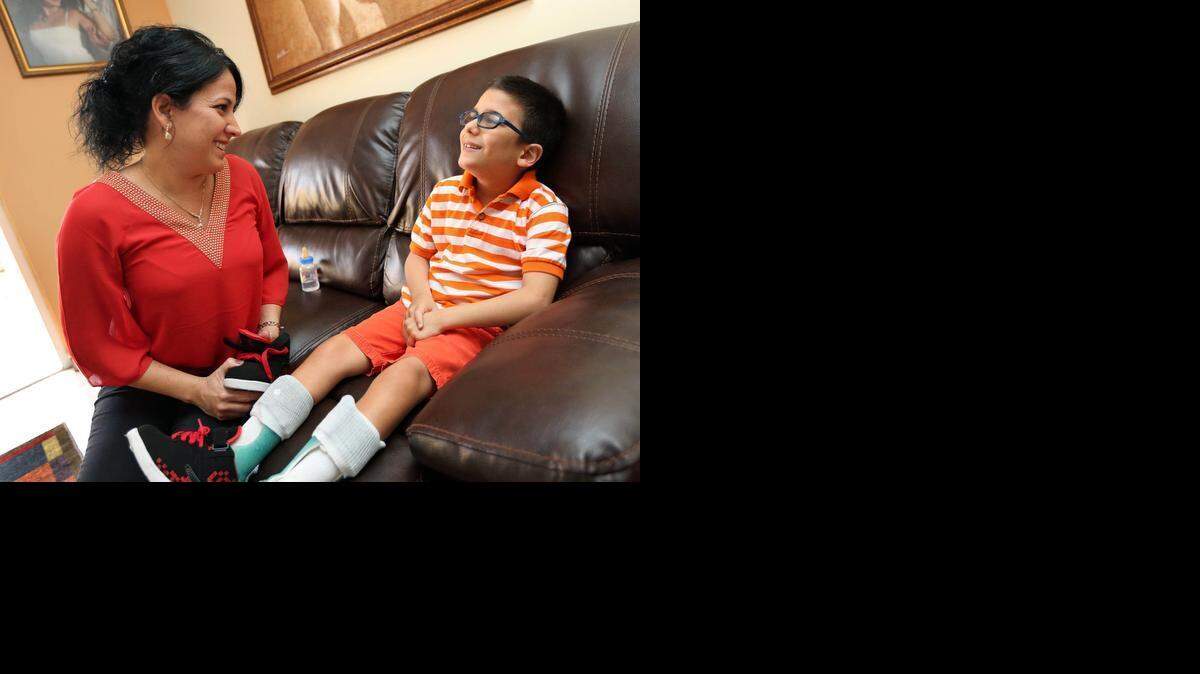
Yordanka Fernández, a 38-year-old mother from Hialeah, says she hasn’t had a good night’s rest for the past eight years. Her voice shakes as she talks about her son Nicholas. She breathes in deeply and tries to hold back the tears.
“I no longer care about everyday problems. If there’s enough money for gas, if I made enough to cover rent … all those issues seem insignificant now,” she said. “The only thing I really care about and that preoccupies me is to see my son Nicholas walk.”
Nicholas Katrib was born on Dec. 24, 2006 at a mere six months in gestation.
“I had spent days with an intense pain in my womb but at the hospital told me it was just a bit of acidity in my stomach and that I should take some Mylanta and go home,” she recalls.
But she had to rush to the hospital later because her water broke. During the birth, her arterial pressure lowered and the baby wasn’t receiving oxygen inside the womb. According to the doctor, the baby had spent four days without a placenta.
When Nicholas was born, his organs had not yet fully developed. The growth of his liver, lungs and stomach was stimulated with steroids as was his skin and corneas. He weighed only one pound and was 11 inches long.
“I could tell that he wasn’t fully formed and that he was very small but I hoped that after being inside an incubator for four months he would reach normalcy,” Fernández said.
Fernández and her husband Kyril Katrib returned home with their first born and the hope that the sickly state of their son was due only to his premature birth.
“Time went on but Nicholas wasn’t developing like a normal baby, he almost never cried and couldn’t hold up his own head, which was always to one side,” Fernández said. “We started to notice that his body was very rigid and the worst part was that he couldn’t gain any weight because he barely ate.”
Finally, Nicholas was diagnosed with infant cerebral palsy, a condition that causes the malfunctioning of the area of the brain in control of movement and which in 75 percent of cases produces an augmented muscular rigidity called spasticity.
In Nicholas’ case, the cerebral paralysis also affected his vision, his ability to consume food and speech development and caused him grave consequences in regards to the development of motor skills. He was also diagnosed with a slight level of autism.
“One of the doctors told us to pray to God because our son could become a vegetable for life,” said Kyril Katrib, 37. “The world came crashing down on us at that moment. We had planned everything to welcome our son, we knew what school he would go to when he grew up and we thought we were well prepared. But everything changed so abruptly.”
From one battle to the next
The family was not satisfied with the medical diagnosis they obtained and went ahead with multiple rehabilitation treatments for Nicholas.
“It was constant work to achieve small progress like for him to be able to sit,” said Nicholas’ father. “He started crawling when he was 5 years old.”
Efforts to have experimental treatments covered by the care program for children with disabilities to which Nicholas is entitled to, the family has engaged in many unsuccessful battles with Medicaid.
Because of their limited family income (Fernández cleans houses and Katrib installs fire detectors), the couple has struggled to find ways of providing rehabilitation methods to their son. They’ve creatively used at-home resources to help him, such as different colored lights to aid in his visual therapies, or plastic sticks to help Nicholas learn how to move around inside water whenever he goes to the beach.
Their last investment was a custom bicycle — which they continue to pay for monthly — to stimulate the muscles in his leg.
“The advances that the child has made are miraculous and that’s greatly in part because of the tenacity of his family and especially the devotion of his mother, who has left everything in her life to dedicate herself completely to Nicholas,” said pediatrician Dr. Maria Pol Carballo, who has provided medical care to Nicholas since he was just a few months old. “But there’s still a long path left to travel and that next and most important step is for Nicholas to walk.”
Nico, as the boy is called at school, loves to study and is a big fan of singer Shakira. He also likes songs from the big friendly dinosaur “Barny” and even though he seems shy, when a girl says hello to him he answer “Hello beautiful” and smiles.
“He’s a very lucid kid and he has a marvelous memory. He can talk to you about things that happened when he was 3 years old with an exactitude that’s really surprising,” said Melania “Tere” Batista, the teacher’s aide and therapist at Nicholas’ school, Milan Elementary. “Nico can have a great future.”
When Nicholas began classes two years ago, he would still drag himself across the floor in order to move around. After a surgery on his legs and a diverse series of therapies — sometimes very painful ones — he’s now able to move himself in short distances by using a special walker.
“He does it with perseverance but he’s aware that he’s the only child, in the class of 12, who can’t walk and sometimes that gets him down and he gets sad,” said Batista. “He’s told me, ‘Teacher Tere, I want to walk like the other kids’.”
The use of the walker is also uncomfortable for Nicholas because his muscles aren’t strong enough to support his weight.
A glimmer of hope
That’s why his mother has set off on a relentless quest to make sure her son can achieve walking and going to the bathroom on his own and maybe one day even run or practice a sport.
“I want my son to be independent because if one day I’m not here to take care of him I want to know he’s going to be OK,” said Fernández, who couldn’t hold back tears any longer.
The family’s biggest glimmer of hope is an Intensive Therapy with Lokomat, a robotic device that works as a skeleton and moves the legs of patients in a normal way, training their muscles to walk. This treatment is offered solely at the Rehabilitation Institute of Chicago.
According to Mathew Gingsber-Jaeckle, global services coordinator at RIC, Nicholas is a good candidate for the intensive treatment offered in the summer, which runs for eight weeks, three of them in which “several motor skills rehabilitation experts will design an integrated therapy plan specialized for Nicholas, not only to help him walk but also so that he can achieve independence in the performance of daily activities such as getting dressed and going to the bathroom.”
However, Medicaid doesn’t cover the costs of the intensive treatment, which costs $36,000, including a 20 percent discount given to the family by RIC. The institute was also able to secure free room and board for the family in Chicago, “but due to the high maintenance costs and the work of the specialists, it’s not possible to help them any more than that,” Gingsber-Jaeckle said.
Hoping to see her son walk, Yordanka Fernández started the Nicholas Katrib Foundation via the website www.gofundme.com. She clings to the hope of gathering enough money so that her son can receive the intensive therapy treatment this summer.
“This is a decisive moment for Nicholas to receive this treatment, when his body is still in the formation process and the muscles can be trained to function,” said Dr. Pol Carballo. “Later on, malformations might become irreversible.”
To make a donation and help Nicholas Kubrid, visit www.gofundme.com/NicholasKatribFoun.
Follow Estephani Cano on Twitter: @EstephaniCano
This story was originally published April 2, 2015 at 5:17 PM.