
Coconut Grove neighbors band together to save home
For years, residents of St. Gaudens Road, a quintessential south Coconut Grove street, watched warily as overscaled McMansion after McMansion gobbled up old homes and devoured the lush, overgrown charm of neighboring blocks.
So when a limited liability company bought and sought to demolish a grand, near-pristine 1920 Mediterranean villa on their street—one designed by Miami’s most important early architect for a Grove pioneer, no less — they say they decided it was time to take a stand.
In an unusual move, the St. Gaudens neighbors, who include descendants of the Grove’s earliest settlers, banded together to fight the presumed speculator, starting a website, http://www.savethegrove.com/, and commissioning a prominent Miami historian to draft a report to the city of Miami asking that the home be protected as an architectural and historic landmark.
“It happens to be a beautiful house,’’ said Jennifer Beber, president of the St. Gaudens Road Neighborhood Association. “It’s so perfect-looking. But why preserve a beautiful old house when you can split the lot and build two houses?
“Because that’s what this is all about—it’s about greed. It’s a developer who has no interest in what the Grove is all about. And there is so much of this happening. But this is one where everyone said, ‘That’s enough.’ ”
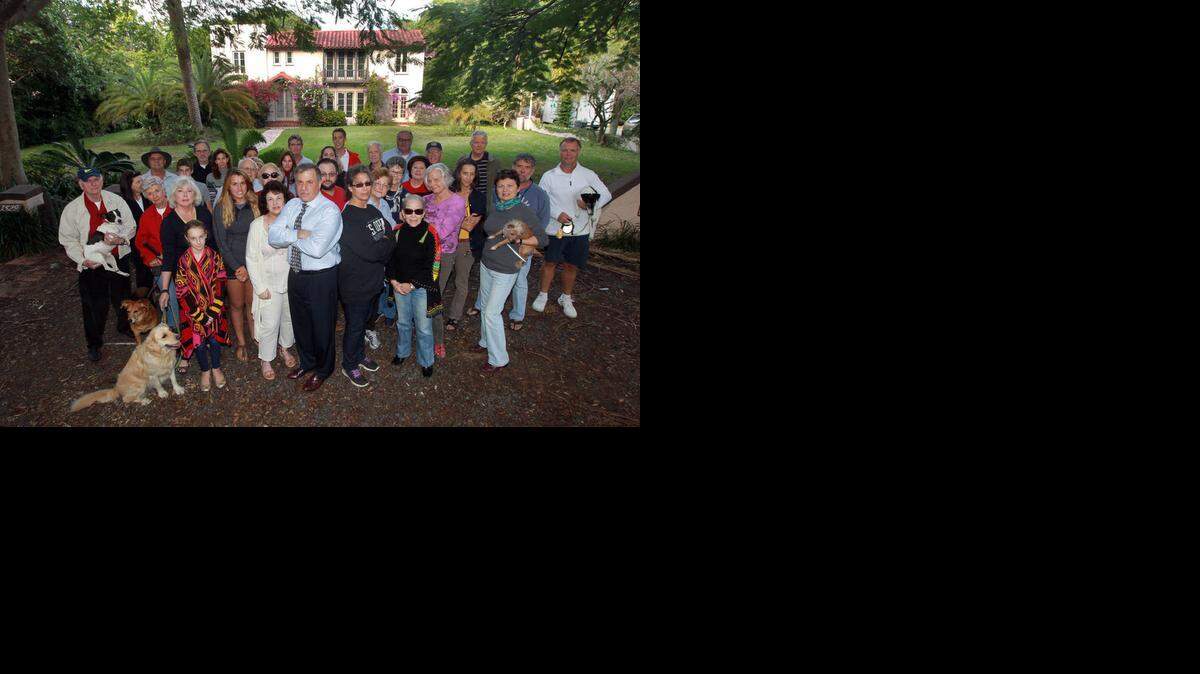
The call to save the house appears to be resonating with Grove neighbors. When the Herald asked Beber and two other supporters to pose for a photo at the house, 32 additional people showed up for the shot on the Friday after Thanksgiving.
Even more unusually, at a time when a massive development boom has led to what preservationists describe as a demolition derby of historic and architecturally significant early homes and buildings across Miami and Miami Beach, they may have a chance of succeeding.
The city’s preservation board will vote Tuesday on whether to consider the house, 3529 St. Gaudens, for historic designation, a move that would extend a moratorium on demolition until a final decision is made. The city preservation officer, Megan Schmitt, is recommending a “yes” vote after concluding the house likely meets three of the legal criteria for protection, which means the case for saving it is a strong one.
Even the Coconut Grove Village Council, an elected body that advises the city, has stepped into the fray, approving a resolution in favor of designation.
The position of the house’s new owner regarding designation is unknown.
The Miami-Dade County property appraiser’s website shows the 2,700-square-foot house was bought for $1.575 million in March by a firm identified as HUS LLC. Bragi Sigurdsson, a broker at One Sotheby International Realty in Miami Beach who is listed as HUS’s manager in state corporate records, did not respond to several requests for an interview on his cellphone voicemail and through email.
HUS has applied for a demolition permit and for a replatting of the roughly half-acre property to divide it in two, a common tactic by real-estate speculators to maximize profit by shoehorning two expensive new homes onto valuable land.
HUS has asked the city to put off Tuesday’s vote, but the St. Gaudens group is opposing any delay, calling the request a stalling tactic.
“Everybody thinks this is a winner,’’ said Richard Zelman, a lawyer who lives across the street from the house. “We’ll see. To lose this house would be losing a physical manifestation of Coconut Grove history, and this is a wonderful example of that. As we mature as a city, we need to learn that it’s not just about tearing down old stuff and building new stuff. We need to value some of those historical roots.”
The historic roots on St. Gaudens, one of the oldest streets in the Grove, run deep.
Originally Ozone Avenue, it was renamed for famed 19th Century American sculptor Augustus St. Gaudens, whose widow lived on the street. Today it’s home to several members of the Munroe family, descendants of Commodore Ralph Middleton Munroe, whose 1891 Grove house, the Barnacle, is a state park just a few blocks away.
It’s also one of the few streets leading to Biscayne Bay that doesn’t have a guardhouse at the entrance.
“On this street there is a history of doing the right thing by the community,’’ Beber said. “We’re not gated. Anyone can walk in.’’
The house in question, which a report by historian Arva Moore Parks dates to 1920, is one of the oldest on the street, which according to Beber boasts at least eight homes from the period. It was built by Albert William Frantz, who along with a St. Gaudens neighbor, Harold deBussy Justison, headed the Sunshine Fruit Company — ironically, perhaps, an early and important Grove developer. Frantz owned the house until 1943, according to the report. The subdivision is named after Justison and Frantz.
The two-story L-shaped house, with a picturesque wooden balcony overlooking the front yard, was designed by Richard Kiehnel of Kiehnel and Elliott. The firm introduced the so-called Mediterranean Revival style to Miami with its design of the El Jardin estate, today home to the Carrolton School, in 1917.
Kiehnel also designed some of Miami’s best-loved buildings, and is credited with an unusually high number of entries in the National Register of Historic Places. Among those: the Coconut Grove Playhouse, Coral Gables Congregational Church, Miami Senior High and Coral Gables Elementary, as well as a score of homes in Miami’s historic Morningside neighborhood and in the village of Miami Shores.
“It’s really amazing the legacy this man has,’’ Parks said. “If anyone wants to study the Mediterranean style, that’s where to start.”
Also vouching for the house’s value: Miami-Dade College professor and HistoryMiami historian Paul George.
Schmitt, the city preservation officer, said in a brief analysis that the Frantz house qualifies for designation because it embodies the historical period in which it was built, is an outstanding work by a prominent designer, and exhibits materials and craftsmanship of unusual quality.
Parks said the house has been altered little and has unusually well preserved details, including a rarity: what appears to be the original polychrome tint on the exterior balcony balustrades, a characteristic detail of the 1920s Mediterranean style.
The house, which until its sale was owned by descendants of Frantz, also appears to be in very good shape, say neighbors who were recently in it as guests.
The city’s receptiveness to the St. Gaudens’ neighbors plea comes at what some preservationists say is a troubling point for historic preservation, in particular of significant older houses. In Miami Beach, for instance, the city commission has pointedly declined to enact strong protections for its treasure trove of early and mid-20th Century homes as speculators buy up stately waterfront estates to replace with often gaudy mega-mansions.
On St. Gaudens Road, residents say they’re hoping manifest public unhappiness with the destruction of old places signals a turning tide. Parks notes that the Kiehnel house could accommodate a sensitive addition, and improvements would qualify for a tax abatement, so that the developer could still walk away with a tidy profit.
“My grandmother was at the Barnacle, and she believed in preserving history,’’ said Charles Munroe, a great-grandson of Commodore Munroe and, along with his sister, a St. Gaudens resident. “She was tired of fighting off developers who wanted to increase the density, so she sold it to the state of Florida. Now it’s kind of, ‘Here it goes again.’
“Developers are always going to be around looking to make money quickly, but they’re not the ones living in the community. We’ve got to draw the line somewhere to protect our community.”
This story was originally published November 28, 2014 at 8:35 PM with the headline "Coconut Grove neighbors band together to save home."