
Miami-Dade moves fire boat south, ends Miami partnership
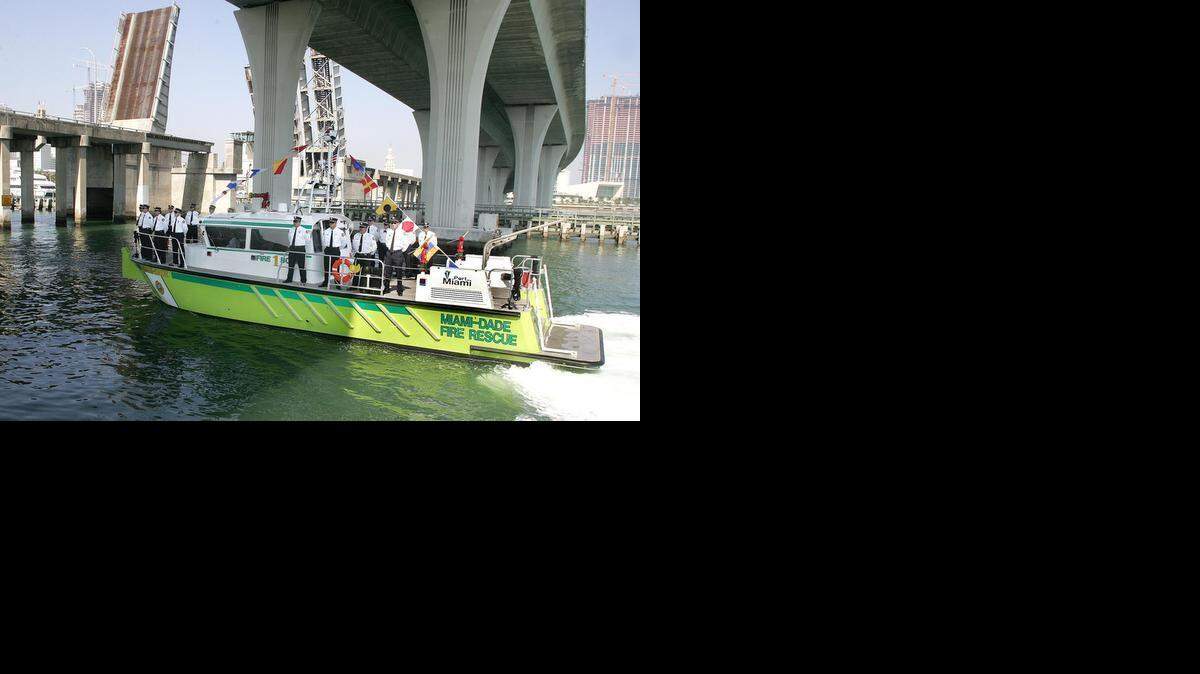
After only three months, Miami-Dade has dry-docked its plan to station a county fire boat in northern Biscayne Bay and ended joint staffing with Miami’s own marine squad.
The county recently pulled its fire boat from a marina on the 79th Street Causeway and shifted it five miles south to PortMiami, according to government and union officials.
Miami-Dade’s move unwinds a central element of a plan trumpeted by County Mayor Carlos Gimenez to share fire-boat duties with other governments in order to provide expanded marine coverage. Now Miami and Miami-Dade each have their own fire boats docked practically within sight of each other: Miami-Dade’s at PortMiami and Miami’s at the nearby Bayside Marina.
“It seemed like something that could be successful,” said Dave Downey, the county’s fire chief. “It just didn’t work out.”
The short-lived arrangement had the county’s 50-foot fire boat begin service in October at the Pelican Harbor Marina on the 79th Street Causeway, with the crew operating out of a nearby city station. Miami filled one slot in the county’s four-person crew, while Miami-Dade did the same for the city’s boat at Bayside. Both departments were training Miami Beach firefighters to join the rotation, but Miami-Dade ended the arrangement in December.
“We did exactly what we committed to,” Miami Beach Fire Chief Virgil Fernandez said. “We’re still training with Miami.”
Downey noted that the core of Gimenez’s plan remains intact: One of the county’s two fire boats, both idle since 2012, is now back in service. But the county has scuttled joint operations that allowed Miami’s boat to handle the center of the bay while Miami-Dade’s vessel took on the northern part.
“It’s a shame,” said Sally Heyman, a Miami-Dade commissioner whose district includes some of the causeway as well as waterfront cities like North Bay Village and Sunny Isles Beach.
Heyman has been pushing for a fire boat to be deployed even farther north, near the Haulover Inlet, and says the ritzy high-rise canyons and waterfront mansions in her jurisdiction pay enough property taxes to merit a boat nearby.
“I’ve got all the coastal cities up here,” she said. “They’re donor communities. They want the boat.”
Fire boats have been a flashpoint since Gimenez took office in 2011 and idled the county’s two-vessel fleet over budget concerns. Gimenez said there were so few marine calls that he wanted the boats folded into ground-based rescue squads. The county’s fire union objected, saying it would only accept full-time, dedicated crews for the fire boats.
The long-simmering stand-off exploded into a controversy for Gimenez on the Fourth of July in the wake of a horrific boating collision off the waters of Miami’s Coconut Grove. The calamity left four people dead, including the adult son of Jack Garcia, a retired pilot of one of the idled county fire boats. Garcia publicly excoriated Gimenez over the idled fire boats (though a squad of smaller emergency vessels did respond to the scene).
Garcia launched a poorly funded recall effort against Gimenez that never gained traction but still drew attention from the mayor’s camp. One of Gimenez’s top political supporters, Rodney Barreto, reached out to Garcia to talk about him dropping the recall effort, and mentioned the mayor’s pending announcement of a plan to get fire boats back in the water.
That plan envisioned a novel nautical collaboration among Miami-Dade and the cities that dot Biscayne Bay.
Miami was already operating its own fire boat out of Bayside when the July 4 boat crash occurred. Miami-Dade’s two fire boats were docked about 2,000 feet away at PortMiami, but remained unused amid Gimenez’s stand-off with union leaders. The tentative agreement brokered by the Gimenez administration in September called for Miami and Miami-Dade to share staffing of two fire boats, and then train firefighters from Miami Beach to join the crew.
The hope was that Coral Gables and Key Biscayne would eventually lend personnel to the rotation, and allow for a third jointly operated rescue vessel to be added in southern Biscayne Bay.
In October, Miami-Dade and Miami began jointly staffing their two boats and Miami Beach sent firefighters to train for full-time slots on the vessels. But Miami-Dade pulled the plug in December, before Miami Beach was ready to replace a county crew member, Downey said.
It wasn’t entirely clear why Miami-Dade ended the arrangement it had designed. The joint staffing arrangement may not have led up to initial expectations. Downey said Miami Beach was tight on firefighters, making it a challenge to participate. Fernandez said he provided one staff member 24 hours a day for Miami-Dade’s boat, as called for in the agreement. Later, he said, Miami-Dade wanted more.
“They wanted me to increase personnel,” Fernandez said. “I said: I need to budget for this.”
Downey also faced the extended fight with the county’s fire union, which demanded a full-time boat crew out of PortMiami. Though Gimenez, a former Miami fire chief, opposed that staffing plan since taking office as wasteful, that’s now how Miami-Dade is operating its fire boat.
“We have a station built specifically for the fire boat in PortMiami,” said Al Cruz, president of the county firefighters union. “It was the ultimate goal to put the boat back in service with four of our people.” Garcia, the retired fire-boat operator, agreed. “It’s back to where it was when I was there,” he said. “I think it’s an awesome idea.”
Fernandez and Miami’s fire chief, Maurice Kemp, both said they were willing to continue the collaboration, but Miami-Dade opted to end it.
“That was an operational decision made by the county,” Kemp said. “They have a fully staffed boat. We have a fully staffed boat.”
Kemp said the joint training and coordination was helpful, and could lead to reviving the original plan in the future. “Miami Beach is still training with us,” he said. “A lot of good came out of the regional cooperation.”
Downey said the five miles that separate the 79th Street Causeway and PortMiami don’t amount to much of a difference for the high-speed fire boat. “The distance is negligible,” he said. “Most of our calls are in the south, anyway.”
Even so, Downey said the ultimate goal is to get a boat stationed north at Haulover. “I haven’t given up anything up there,” he said.
This story was originally published February 7, 2015 at 7:00 AM with the headline "Miami-Dade moves fire boat south, ends Miami partnership."