
Neighbors, city officials remain at odds over Merrie Christmas Park
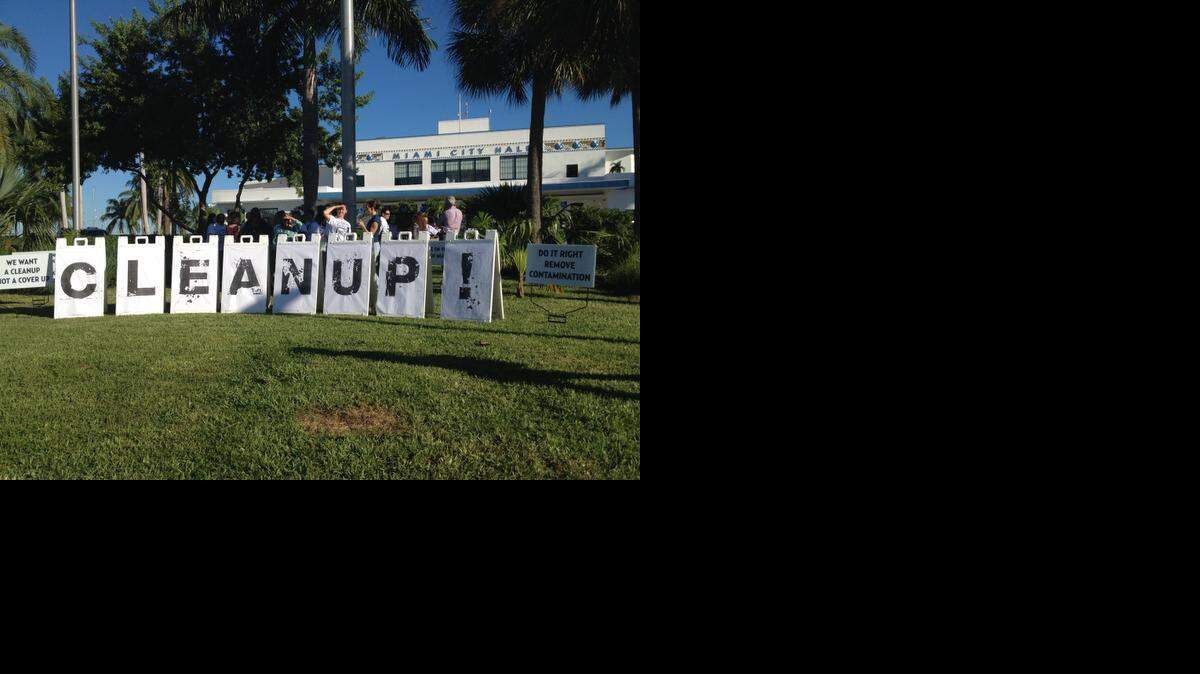
If the neighbors who live around contaminated Merrie Christmas Park want tons of tainted soil removed from the bowl-shaped lawn that borders their properties, they may have to pay for at least some of the cost themselves.
Miami officials on Thursday explained during a belated public hearing on their remediation plans that ongoing efforts to cover tainted soil with two feet of clean fill is not only safe but practical. Their statements were backed by a contracted engineer, the chief of the county’s environmental restoration monitoring, and by Richard Weisman, director of the Florida Poison Information Center.
But if dubious residents do still want to remove a massive mound of unearthed, tainted soil — and many of them do — Miami Commissioner Marc Sarnoff told them they would need to foot about one-third of the $175,000 bill themselves. The rest he said would be privately fundraised by himself and a supportive commissioner from Coral Gables, which borders the 5.5-acre park on LeJeune Road and Barbarossa Avenue.
“It would be nice to see the number five-oh,” said Sarnoff, as the figure, $50 thousand, residents would need to kick in.
Merrie Christmas Park has been closed for more than a year after the discovery of toxic metals like lead and arsenic, likely linked to dumped ash from an old city incinerator. The city began work last month to cover tainted soil under a county-approved plan, but neighbors began to push back after they learned that the city wasn’t removing the soil, but capping it and even spreading some of it to regrade other areas of the park.
“None of us want to be guinea pigs for science,” said Leslie Schreiber, who said she held a birthday party for her 4-year-old twin boys in the park the day before it was closed.
After weeks of pushback, petitions and media attention, the city halted some of the work at the park, where contractors in hazmat suits are working on backhoes, and called Thursday’s meeting. Most of their efforts during the meeting focused on explaining their plans and urging residents to reconsider their stance that removing all the tainted soil — which runs as deep as eight feet — is the only safe option.
“The process of digging it up and getting it out, we don’t have the ability of doing that without allowing some of it to get in the air and knowing the danger,” explained Weisman.
But some neighbors remain skeptical, even questioning Weisman’s credentials. They remain dubious after the city did little to share its plans with the surrounding community. It’s unclear after the meeting how the city and neighbors will move forward, though some have hired attorneys to represent their interests.
“I don’t want to be scared from taking [the soil] away,” said Ken Russell, a resident who has led the opposition to the city’s plans. “I don’t think we need to fundraise, I think the city should just take it out.”
This story was originally published October 16, 2014 at 8:39 PM.