
Gas prices in Florida headed to below $3 a gallon
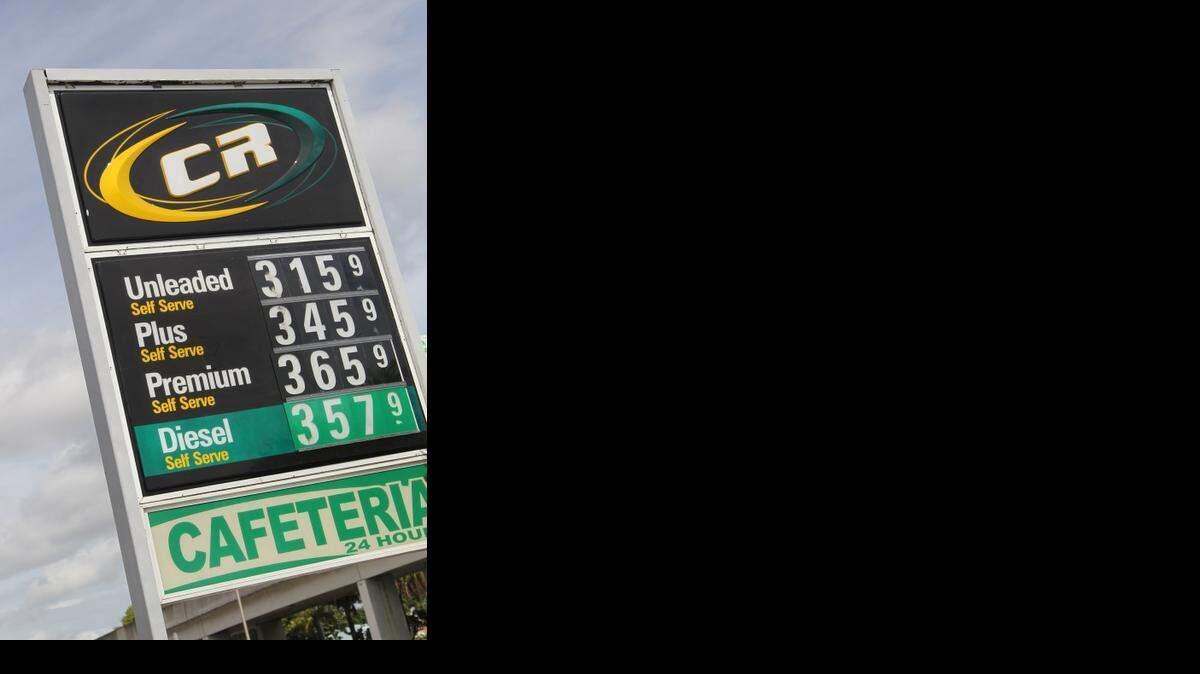
Your calendar isn’t on the wrong page, it just feels like 2010. LeBron James is in Cleveland, U.S. warplanes are dropping bombs on Iraq … and gasoline is back to $3 a gallon — or less.
Surging U.S. oil production, sagging worldwide demand and, perhaps most importantly, the first OPEC price war in 30 years have combined to send gasoline prices into a tailspin. Across the nation, gas has dropped 21 cents a gallon in the past month and could fall another 20 cents or more by November, industry analysts say.
“In the past week, we’ve seen a lot of Florida stations selling gas for $3 a gallon or even below that,” said state AAA spokesman Mark Jenkins. “And as the weeks pass, we’ll see more of them.”
That $3-a-gallon gasoline has hit South Florida in some places already. AAA’s price survey shows several stations in Miami and Hialeah offering unleaded regular for $3.09 a gallon, with dozens under $3.20 and at least one Marathon station in Hialeah is selling for $2.99. The average price around the state, according to AAA, is $3.21.
“The price is down, the price is tumbling,” Jenkins said. Seven states have already broken the magic $3 level — be sure to fill your tank if you drive through Missouri, where the $2.88 price is the cheapest in the country — and if the national average drops to that mark, it would be the first time since December 2010.
Gasoline prices almost always decline in the fall, as summer vacation ends and refiners switch to cheaper winter grades of fuel. But virtually everybody agrees that this abrupt drop is something much more profound.
“This year there are a lot of potential catalysts on the table to make this the most significant decline in a long time, and possibly the most long-lasting,” said Patrick DeHaan, the senior petroleum analyst at the website GasBuddy.com. “It will probably bottom out in mid-December, but it might take a long time to rise up significantly.”
Ordinarily, political upheavals in the Middle East — like the civil wars raging right now in Syria and Iraq — send the prices of crude petroleum soaring. But that isn’t happening — partly because improved oil-extraction technology has made the United States the leading petroleum producer in the world, partly because economic slowdowns in Europe and China are reducing demand.
“The real wild card, though, is OPEC,” DeHaan said. When Saudi Arabia announced last month that it was cutting prices by as much as $1 a barrel, Iran and Iraq promptly declared their own price cuts. The downward pressure on prices has continued ever since, culminating Tuesday with a drop of 4.5 percent on the New York Mercantile Exchange — the largest single-day decline in more than two years.
The reasons for the Saudi price cuts remain murky. Many analysts, including DeHaan, believe there’s a deal afoot between Saudi Arabia and the United States to force prices lower to punish Russia, a major oil producer, for its military meddling in the Ukraine.
“It’s easy to imagine that we sat down together on a couch with the Saudis and we said, ‘Hey, old friend, the Russians are not paying attention to our economic sanctions. Maybe you could help us out here,’” DeHaan said. “A deal like that would punish not only the Russians, but some other oil-producing countries Washington is on the outs with, like Iran and Venezuela.”
A similar accord between the Saudis and President Ronald Reagan in 1985 triggered OPEC’s last price war. It is believed to have cost what was then the Soviet Union as much as $20 billion a year and sent its economy into a dive from which it never recovered.
How the rest of OPEC will react to the price war is just one of several hard-to-predict variables that could affect how far oil prices will decline and how long they’ll stay down. Another is the spreading worry over Ebola.
“It’s very hard to know how consumers are going to react as new cases of Ebola pop up in different countries,” DeHaan said. “If everybody wants to stay home and not be around other people, it’s going to reduce gasoline demand further. But it also could affect the rest of the economy if they stop buying. There are so many angles to this thing.”
This story was originally published October 15, 2014 at 8:00 PM with the headline "Gas prices in Florida headed to below $$3 a gallon."