
Hiking China’s Great Wall, the wild and free way
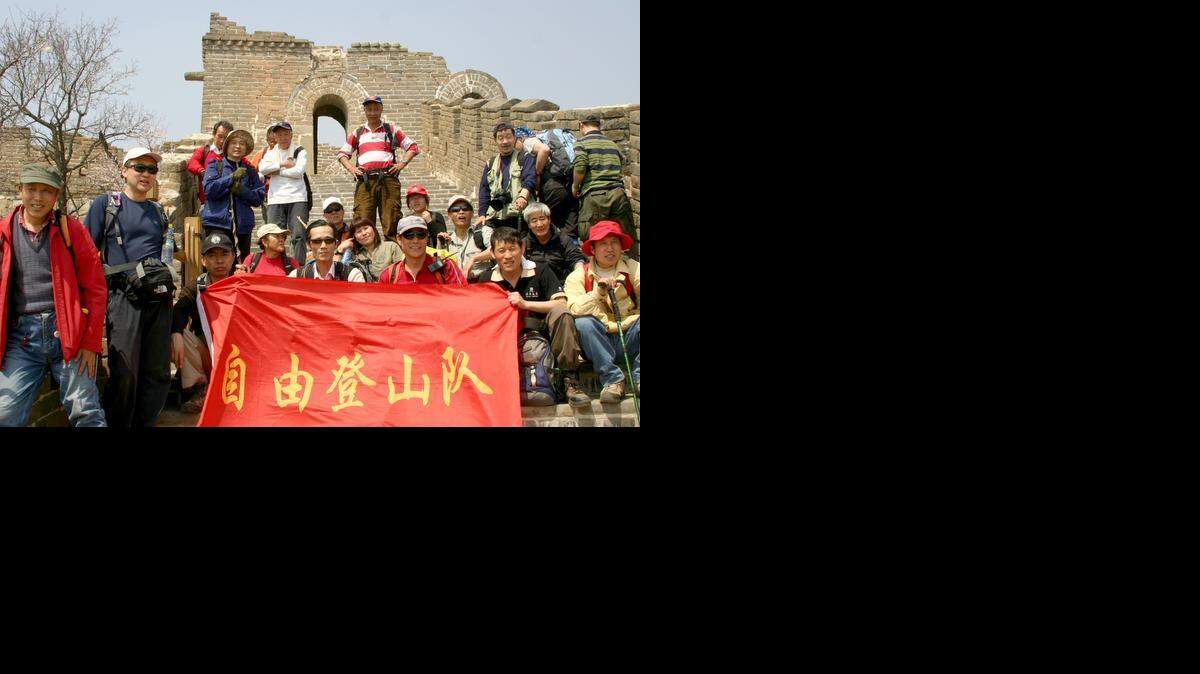
On the outskirts of Beijing, it’s easy to find a ride to the Great Wall.
The drivers of black cabs — unregistered taxis and vans — call out to me in broken English. Some pull at my clothes.
“Sir! Great Wall! Great Wall! I take you!”
“Great Wall! One hundred kuai!”
“Fast car! You come!”
But I defer to companions on the Freedom Team, a group of 25 middle-aged Chinese hikers. “Don’t talk to me,” I say, switching to Mandarin. “Talk to the man with the green walking stick. He’s in charge.”
I point to Sun Zhenguang. He’s in his late 50s, with a dark, saggy face and huge lips. The other hikers call him Old Sun. He wears knockoff aviators and a Red Sox cap.
The drivers converge on Old Sun and the Freedom Team. It’s like a standoff between rival gangs, although they’re just negotiating a price. Once they settle, we hop into a few small vans and set off.
We’re in Huairou, a rural district in the mountainous outlying regions of Beijing. It’s here, a two- or three-hour drive from downtown, that you’ll find some of the most spectacular sections of the Great Wall.
My fellow hikers are largely outliers in China. Old Sun once told me that Chinese tend to find hiking as sport bizarre — a kind of countryside hardship that people in the modern world were supposed to have escaped. But as China’s economy has grown, recreational hiking has attracted some urban professionals looking for an outdoor pastime.
Several years ago, Old Sun and some friends began hiking on weekends with a tour group that charged a fee. After a year or so, they quit paying the fee and started hiking themselves — freely. The Freedom Team was born. I’ve been hiking with them since 2006, when I was an exchange student and Old Sun was my host father.
“Some teams have requirements of their members,” Old Sun explained. “Maybe if you go hiking somewhere with another group, they’ll remove you from their team. But here we’re really free — you can join in our outings, or you can choose not to. If you don’t like our contingent, you can leave, and if you decide later that other teams aren’t that good but that we’re still okay, you can still come back. Coming and going is just very free. So freedom is the special characteristic of our group.”
I’ve been hiking with them since 2006, when I was an exchange student and Old Sun was my host father. Much of the slang I learned that year came from the hikers, and Chinese friends my age sometimes made fun of me for using colloquialisms of the older generation. I couldn’t help it, though. The Freedom Team was chatty. It still is.
For hikers across Beijing, the Great Wall is as functional as it is legendary. Thick, dry shrub covers the mountains here, and a trail with a view is a rare find. In contrast, the Great Wall is an elevated highway, although sometimes a disintegrating one. When the Freedom Team comes to the occasional cliff or eroded section, the hikers start bickering over whether to go up or maneuver around it. At some point, an impatient member inevitably breaks the impasse and starts climbing. From below, the rest of the hikers turn into a judgmental peanut gallery.
I first watched such an ascent in 2007 at Jiankou, a common first “wild” wall for hikers. Unlike heavily trafficked tourist sections that construction crews have refinished to resemble Disney World, wild walls remain basically untouched — some of them since the Ming Dynasty (14th to 17th centuries). They also don’t have entrance fees; the Freedom Team doesn’t do entrance fees.
Today we are hiking a wild section just east of Jiankou known as Beijing Jie, or Beijing Link, where the wall divides into two sections, running parallel west toward the Gobi Desert. There’s a common misconception that the Great Wall is a single continuous structure, but this split is one of many.
We arrive at a small village and get out of the vans. The Freedom Team members are better-equipped than they were when I first knew them. Over the years, when one member bought some bit of hiking gear, the others followed. Now the entire team is outfitted in ultra-light backpacks, adjustable hiking poles, kneepads, gloves and — although it rarely rains in Beijing — quick-drying outerwear.
We cross a dry riverbed. Ahead of us, a path winds its way through terraced fields of walnut trees, leading up to a ridge where the wall clings to exposed rock.
As we begin to climb, my blue jeans seem clumsy compared to their light hiking pants. When I reach the wall, my blond hair draws the attention of a group of Manchurian tourists, who surround me for a photo. We hike east for another half hour or so until we reach the split of Beijing Link, where we stop at a guard tower — one of many spaced out along the wall — and break for lunch. Everyone shares everything. Three people offer me cucumbers.
A lonely pine grows out of top of the wall in front of us, the sole shelter on the windswept ridge. Gusts scour the mountainside and rustle the shrubs below. Lower down, pink blossoms faintly coat the valleys. The wall slithers over ridges like a snake, clinging to exposed rock, until it fades away in the distance.
The air seems drier than on other Great Wall hikes I’ve taken, and my clothes are covered with a thin layer of dust. The sandstorms are getting worse in Beijing, scouring the city each March as the Gobi Desert expands. My hair feels like straw, and when I shower that night, the water that rinses off my scalp is a light brown hue.
Except for the few weeks of sandstorms, springtime is generally a good time to hike the Great Wall: not too hot or cold, with the mountainside beginning to blossom. In the summer, Old Sun often turns to hiking at night to catch sunrises, escape the heat and avoid paying entrance fees.
On a trip four years ago to Shandong’s Mount Tai, three American friends and I trekked with the Freedom Team from 11 p.m. until noon the next day. The team used flashlights, and we used our cellphones, to find our way through pitch-black fog. We slept at the summit, and we made a scene: Our rest was interrupted by Chinese tourists taking our picture.
Old Sun is used to hiking with young Americans. His son attended a high school that ran a small American-immersion program, and his family has hosted 11 American students, including me. We all hiked, and Freedom Team members still mix us up. They remember us as “the fat one,” “the tall one,” “the Indian one,” “the Jewish one.”
.
Political discussions have always been a feature of Freedom Team hikes. My presence as a Chinese-speaking American inspires debates about Sino-U.S. relations, and people point at me when they refer to the United States.
On a hike in 2013, some discussed whether Xi Jinping, who had recently assumed China’s leadership, would be better than his predecessors. No one thought there would be much difference. In Chinese, “Chairman Xi” sounds the same read backward and forward, and the Freedom Team agreed this described his vague politics as well. The massive anti-corruption campaign that Xi later launched wouldn’t have anything to do with average Chinese people like the Freedom Team. From the top of the Great Wall, which had seen more than one dynasty, China’s leaders of the moment seemed far away, almost insignificant.
Today I teach Chinese history and contemporary politics in Beijing in the same program I once attended as a student. I try to impress upon my students that China’s authoritarianism is complicated — the government dominates society in some places but is ignored in others. Academics like to call this “fragmented authoritarianism,” and the Great Wall backcountry always reminds me of it. Signs that prohibit hiking are everywhere, placed next to worn paths and entrances to the wall: No one ever obeys them. Villagers construct ladders over steep inclines and drop-offs with no safety regulations or approval to do so. They sell entrance tickets without certification. Some hikers pay and others refuse.
Where the wall crumbles is where there’s the most freedom to maneuver. But in the reconstructed tourist areas, polished for the outside world to see, it’s harder to find a way in without buying a formal ticket.
I’ve always found the crumbling remnants — like China — to be the most compelling: fighting against time while holding on to a withering kind of beauty. That’s where you’ll find the Freedom Team, its members coming and going as they please, calling out to each other as they roam the backcountry ridges.
Going to the Great Wall
The Great Wall sections called Jiankou and Beijing Link are in the Huairou District of Beijing. To do a DIY wall hike, like the Freedom Team, leave from Dongzhimen Bus Station in northeast Beijing. Take the 916 express bus to its last stop in Huairou, where taxis and vans can be hired. Be sure to have a card with your destination written on it in Chinese to give to your driver.
Beijing Hikers, www.beijinghikers.com, 011-86-10-6432-2786. The go-to for foreigners looking for organized trips to Great Wall sections of varying difficulty and “wildness.”
Beijing Sideways, www.beijingsideways.com, 011-86-13-9113-34947. Tours of the Great Wall and the rest of Beijing via a motorcycle sidecar.
Information: www.travelchinaguide.com/china_great_wall/scene/beijing