
Too late for judge to toss Florida’s new congressional map, DeSantis admin says
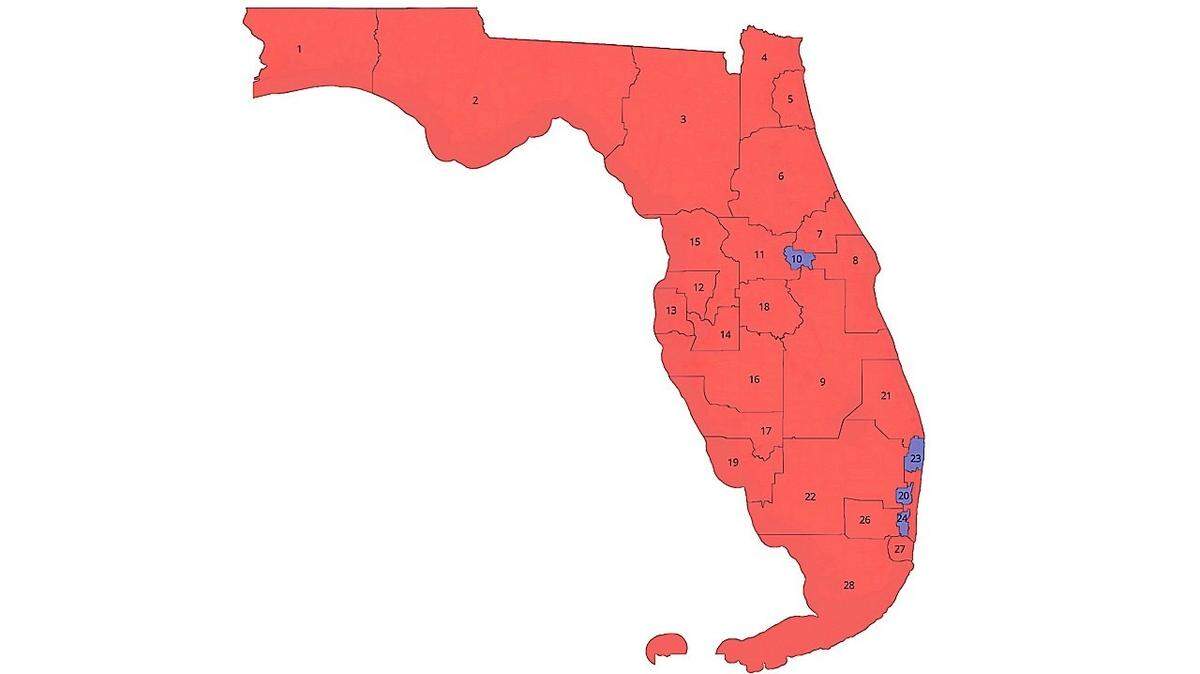
As the state faces the first legal test of its new congressional map, it’s arguing that upcoming elections are too close to make any more changes.
On Friday, a Tallahassee judge heard arguments from groups pushing to temporarily block Florida’s redistricting move ahead of the midterm elections.
Mohammad Jazil, an attorney representing the state, said the court had “no need to rush” and that any ruling should only be done after a proper trial. He noted that maps Florida passed in 2012 were in place for two election cycles before the Florida Supreme Court struck them down.
If Florida’s congressional map remains in place, it could help Republicans keep their control of Congress this fall. That was the goal of President Donald Trump, who last summer began asking red states to redraw their maps.
While Gov. Ron DeSantis has denied creating a map to appease Trump, the first map his office shared was of a red-and-blue colored plan provided to Fox News, which showed Florida picking up four more GOP seats.
Plaintiffs attacking Florida’s congressional plan say it violates Florida’s voter-adopted Fair Districts Amendment, which in part prohibits lawmakers from creating a map that favors a certain political party.
The court consolidated three lawsuits from left-leaning groups into one.
Included are the Equal Ground Education Fund, whose lawsuit is supported by lawyers from the Democratic Party-affiliated Elias Law Group; a group of voters backed by the Campaign Legal Center; Common Cause and the League of Women Voters of Florida.
“The voters of Florida, when they enacted the Fair Districts Amendment in 2010, made a clear proclamation that any level of partisan unfairness in the redistricting plan was too much to tolerate,” said Chris Shenton, an attorney representing Common Cause. “They were tired of it; they had seen it happen over and over again.”
The new map, crafted by a staffer in DeSantis’ office, cuts Democratic seats in Florida by half and favors the GOP to win 24 out of Florida’s 28 seats. Jason Poreda acknowledged that he used partisan data to create the map but said he did not draw it to favor Republicans.
DeSantis’ office has also argued that Florida’s ban on partisan gerrymandering is invalid.
Along with prohibiting redistricting to favor a political party, the Fair Districts Amendment also prohibits lawmakers from drawing maps that diminish minority voting power. DeSantis’ office argues that a recent U.S. Supreme Court ruling means the section relating to race can’t be applied — and says that if one prong is invalid, the other prong can’t stand either.
“The danger is apparent: Allowing a law to stumble along after a court has excised some of its component parts undermines the entire legislative scheme,” the state said in a court filing.
Attorneys arguing against the plan said the map shows clear signs of being designed to favor Republicans. They pointed to Tampa Bay, where the plan removes the area’s lone Democratic seat.
The city of Tampa is split three ways. The southern half of St. Petersburg has become part of a district that runs south and east to include rural Hardee and DeSoto counties.
Jazil on Friday argued that plaintiffs were definitively saying the map was crafted with partisanship in mind despite scant evidence. He said comments from other people, like President Trump, are irrelevant because he’s outside of Florida’s process.
Jazil also said that the groups are disregarding Poreda’s presentation to the Legislature, where he laid out his thought process.
“You have to take Mr. Poreda’s words at face value,” Jazil said.
In the state’s legal filing, Jazil and other attorneys also point to a longstanding principle that tells courts that it’s improper to change election law close to the election.
Primary elections are on Aug. 18, and candidates for Congress need to qualify for the race by June 12.
Judge Joshua Hawkes did not issue a ruling on Friday.
This story was originally published May 15, 2026 at 2:24 PM.