
Ukrainian resilience: What my week volunteering in Kyiv taught me about the war | Opinion
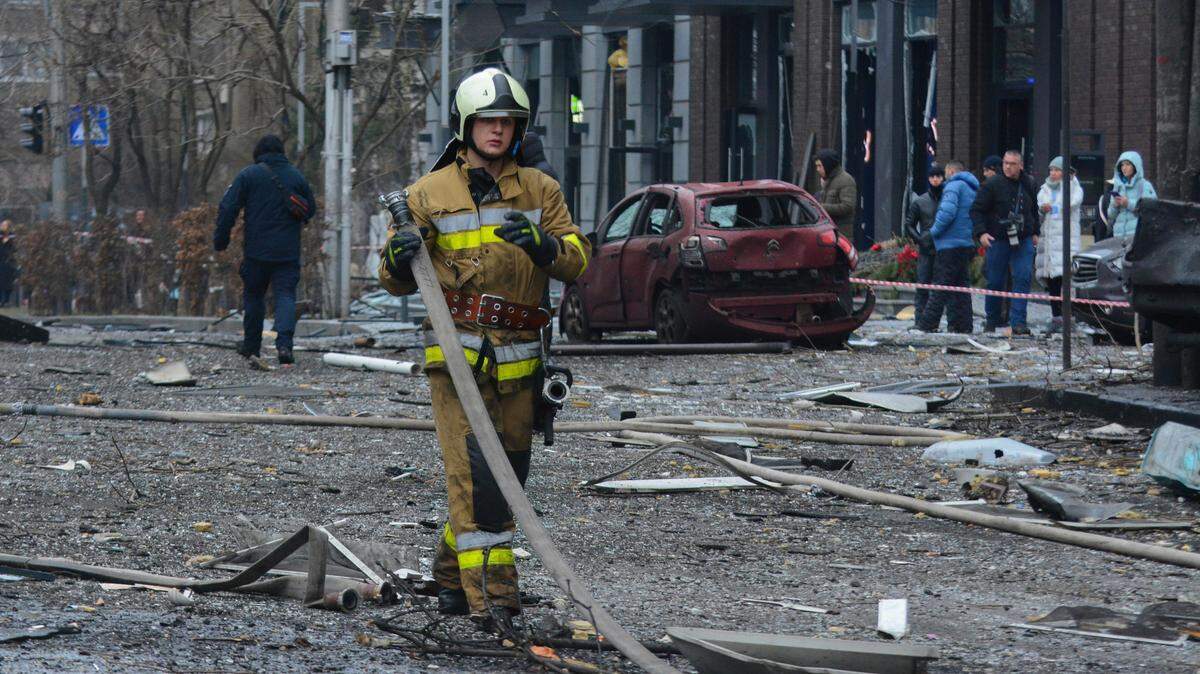
Last October, I arrived in the Ukrainian city of Kyiv as a volunteer to help communities in the path of devastation wrought by the ongoing war with Russia. Born in the U.S. to Ukrainian immigrants who taught me fluent Russian, I followed the war diligently and knew of the horrors occurring there. But upon arriving in Kyiv, what initially struck me the most was struck by the sense of normalcy there. (Russia invaded Ukraine three years ago this month and has been at war with Ukraine since 2014).
Kyiv, the country’s capital, hummed with a vibrancy not unlike the streets of any other major European city.
Occasionally, I spotted men in army fatigues and billboards requesting war effort donations, but my first three days passed, and I could not grasp the effects of the war. Soon, however, things began to change: Air raid sirens rang for several hours at night. And, during my fifth night in Kyiv, an Iranian-made drone made it past the city’s defenses and detonated upon a residential building, killing a 15-year-old girl.
Yet the city continued to hum — coffee kiosks on every corner stayed open, and people of all stripes still went to work. The city felt as sound as the first day that I arrived.
What I learned was that this harsh duality was the norm. I first pieced this together while stowing away in the bomb shelter underneath my hotel. My fellow stowaways — a visiting German professor, a pair of English businessmen and another American — were all weary travelers hiding nervously in the bomb shelter during every air raid. Yet, while we hunkered down, the Ukrainians in Kyiv, including those who worked in the hotel, did not.
They favored boldness in the face of terror. Risking the loss of property or life, they were not ready to risk their liberty. And so their days and weeks went on, living not through the war, but despite it.
Volunteering
In Kyiv, I spent most of my days doing volunteer work with Pecherskiye Kotiki, a wonderful, mostly female group that weaves camouflage nets for the Ukrainian Armed Forces.
We sat before an assortment of various colored strands of synthetic fibers, weaving the fibers onto a chain link fence. While working, I was joined by Yulia, a soft-spoken volunteer in her late 30s, who calmly assisted me whenever I needed guidance.
In addition to her kind and patient demeanor, Yulia represented another common thread in the tapestry of contemporary Ukrainian life: After I told her that I didn’t speak any Ukrainian, only Russian and English, she chose to speak to me in the more surprising of the two — her broken English.
Ukraine is the only truly bilingual country in the world, with most of the population speaking both mother tongues. Yet the decision to abandon the Russian language was a common pattern I noticed throughout Kyiv. Since the war began in 2014 and expanded in 2022, Russian, the dominant imperial language of the past 300 years, has been rapidly losing ground. Previous efforts by the government to encourage top-down Ukrainization, policies aimed at developing the Ukrainian language and culture, have been superseded by a social willingness to build a new cultural identity from the ground up, with the Ukrainian language serving as the scaffolding.
People who had spoken Russian in their homes and with their friends suddenly made the switch to Ukrainian. News anchors who had previously delivered the news in Russian or broken Ukrainian now switched to a sleek, sinewy version of the latter. Ukraine, in the face of its extermination as a nation, began to drop one of its twin mother tongues to not only preserve but to grow its independent culture.
Though my communication with Yulia was significantly limited and my linguistic link to the country was occasionally severed, I was glad that trade had been made.
Kyiv’s suburban landscape
After several evenings of tepid improvement in the art of camo-weaving, I decided to book a day-long tour to see Kyiv’s western suburbs, which played a prominent role at the outset of the war as the setting for the Battle of Kyiv, the keystone for the success of the Russian offensive in 2022. While failing in its objective to take control of the capital and quickly eliminate the national leadership, the offensive resulted in some of the biggest war crimes of this century. I was about to revisit this history.
At 11 a.m. on the morning of my excursion, my tour guide, Svit, a slightly crass but heartfelt army veteran in his late 30s, picked me up and drove me to see these war-stricken towns. The purpose of the tour was to see the semi-reconstructed suburbs of Bucha, Irpin and Hastomel, towns that had fallen directly under Russian occupation during the early weeks of the invasion. Svit showed me the unrepaired remnants.
We passed countless fences still peppered with shrapnel and buildings that had been so obliterated by shelling that all that remained were clumps of bricks revealing a hollow, blown-through center. Even starker were the places I would have otherwise passed over: a church courtyard that had served as a mass grave; a newly paved road that, two years prior, had 70 civilian bodies strewn across it. The cities lived on through specters of tragedy, both physical and psychological.
“Everybody in this town has a story of horrors from the invasion,” Svit told me, “But we don’t know all the stories. Many don’t share them, they want to move past it.”
We returned to Kyiv by 5:30 p.m. The day had been haunting but hallowing. It felt as if we had consecrated the ground on which we stood. We said goodbye, and I wished Svit all the best, knowing that he was eligible to be sent to the front lines at any time. When we parted, he left me with a gift: posters of Vladimir Putin and Russian television anchor Margarita Simonyan marked with bullseyes.
He laughed and said that if I ever needed to practice darts or go to the firing range, I had some easy targets. I laughed, too. Once again, the normalcy won out.
Rebuilding homes
On my last day in Kyiv, I went back to volunteering — this time with Dobrobat, a volunteer construction group that does “rapid restoration” projects in de-occupied Ukrainian territories. Each Saturday, local volunteers dedicate half of their weekend to rebuilding damaged homes.
These projects typically involve the rebuilding of damaged walls, fixing blown-out windows and re-roofing homes, which was my assigned task. At the meet-up site, I was quickly told to get into a beaten-down van hoisting a nationalistic variant of the Ukrainian flag. The van rumbled down the freeway to a quiet Kyiv suburb where a roofless house waited for us. Most of the crew climbed onto the wooden frame atop the house while a few others, myself included, stayed on ground level and hoisted roof tiles up to the men above.
There was Yura, an ex-nightclub bouncer; Misha, a Ukrainian Mormon whose laziness and annoying jokes unnerved the rest of the group; Sergei, an engaging and talkative pensioner who told me that he was in the process of building a museum dedicated to all the foreign aid and volunteer work that had been done in Ukraine; and, finally, Sasha, the group’s charismatic leader, dressed in green fatigues with a Chechen-like beard. They welcomed me into their circle and made me feel at home. Though the day was not easy, their hospitality and dedication to volunteering for their homeland lessened the load and made our effort feel worthwhile.
Ukraine’s resilience
My week in Ukraine came to an end, and I boarded my bus back to Warsaw, thinking about the uncertainty of the future: about how long the war and its bloodshed would continue, and how it would finally end. I found myself surprisingly calm and rational in my thinking. No matter what Ukraine’s precarious future held, one thing was certain: The resiliency and the compassion of the Ukrainian people would hold up. Yet as all this uncertainty swirled around me, I found some solace in the future.
I had now met and worked alongside ordinary Ukrainians, and could see their compassion, resolve and resilience in the face of war. No matter what the precarious future held, one thing was certain: the Ukrainian people would continue to give their all to keep calling Ukraine their home.
This story was originally published February 9, 2025 at 9:00 AM with the headline "Ukrainian resilience: What my week volunteering in Kyiv taught me about the war | Opinion."