
President Trump doesn’t like Jim Acosta’s questions. Neither did dictator Raúl Castro
President Donald Trump doesn’t like Jim Acosta’s questions.
Neither did Raúl Castro when the CNN journalist questioned the Cuban dictator about the taboo subject of political prisoners on live Cuban and worldwide telecasts.
“Why does your country have Cuban political prisoners?” Acosta, whose Cuban father fled the island in 1962, asked in accented Spanish. “And why don’t you release them?”
Acosta’s bombshell question and ensuing exchange with an irritated Castro was the highlight of the joint press conference with President Barack Obama during his historic visit to Cuba in 2016. It was quite the baptism into American-style presidential briefings for Castro – who, accustomed to a fawning state-owned press, stammered confused and answered with a show-me-the-list denial that was promptly quashed by inventories of political prisoners and detainees posted on the Internet.
At another moment in history, Acosta might have found himself on a plane back home for putting Castro on the hot seat. But the CNN chief White House correspondent didn’t get the boot then.
He has now — from the Trump White House. How ironic is that?
After a testy exchange with the president about the alleged immigrant “invasion” from Mexico and the deployment of troops to the border as if it were a war zone, Trump yanked Acosta’s credentials. Trump’s administration has accused Acosta of “placing his hands on a young woman,” an intern who was the one who invaded Acosta’s personal space to take away the microphone he was using to question Trump.
“You are a rude, terrible person,” Trump told Acosta. “You shouldn’t be working for CNN.”
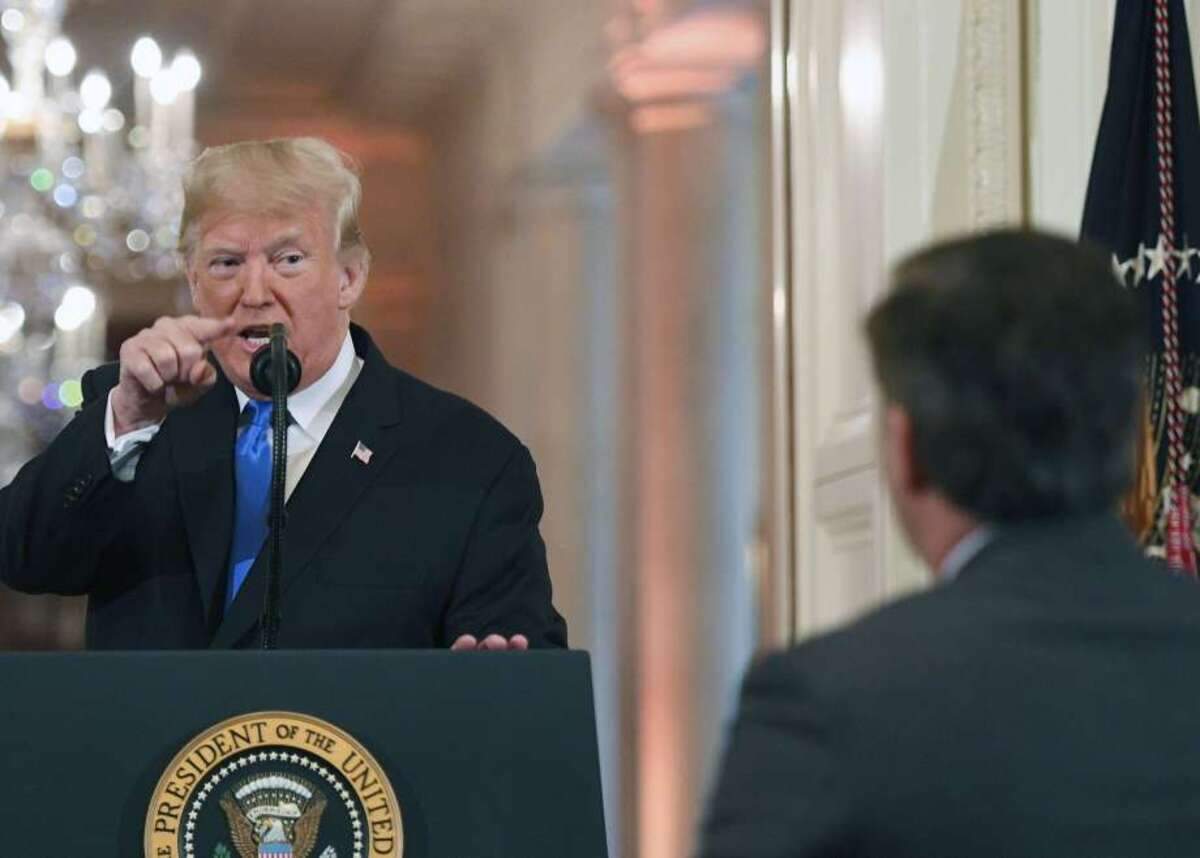
To confuse the public, the White House has even gone to the extent of releasing a doctored videotape of the encounter that makes Acosta’s actions look more aggressive and misconstrues what happened. Setting up videos to make someone look guilty is Castro territory.
What country is this again?
Before he became president, Trump enjoyed largely positive (and trivial) coverage about his wealth, his television show and his celebrity. Later, on the campaign trail, he commanded the media’s attention with one outrageous claim after another that he milked for maximum exposure.
But Trump the president has been on the warpath with the media from day one, infamously referring to journalists as “the enemy of the people.” Every time he doesn’t like reporting or opinion on an issue, he calls it “fake news.” He has sought to intimidate journalists by saying he’ll take away broadcast licenses and strengthen libel laws. Annoyed at losing Republican control of the House in the midterm elections, he has gone on epic rants on Twitter that have become even more unhinged.
The hatred toward the media he’s fueling is dangerous — and, if Americans value their freedom, they shouldn’t stand for it.
CNN has filed a lawsuit, backed by 12 news organizations including Trump-friendly Fox News, seeking to have Acosta reinstated to his post and arguing that his removal constitutes a violation of his First Amendment rights to freely report on government. Call and write to the White House and let them know this isn’t how an American president, who is supposed to be the chief defender of our freedoms, should behave. Tweet to the president, @realDonaldTrump, that you #StandWithAcosta.
Asking our president tough questions is at the heart of American democracy. It’s one of the pillars that sets the United States apart from dictatorial regimes.
Could Acosta have phrased his questions in a more neutral tone that, as the Poynter Institute for Media Studies in Florida has argued, makes for better journalism?
Perhaps.
But Acosta’s direct style is no reason to ban him from the job he has held for two administrations — and sets a terrible precedent, a step toward the erosion of press freedoms.
President Obama didn’t fare any better when Acosta, who covered the Iraq war from Baghdad, asked questions about his underestimating ISIS. But the difference is how Obama responded, not with personal attacks against the reporter, but by further elaborating his arguments.
Trump rails against journalists because he doesn’t know how to properly make a case for the policies he believes in without lying or agitating his base of supporters — and becoming agitated himself.
It’s Journalism 101: Journalists ask questions. The subjects don’t always like it. Sometimes you have the time and the luxury to work up to hard, confrontational questions in an interview. Sometimes you only get one quick shot at it.
The latter is the scenario in packed White House briefings.
Like the dictators he has praised for being “loved” by compliant people, President Trump would like nothing better than to be surrounded by journalists who hurl flattering questions about his overall greatness, natural aptitude for the presidency, and the eloquent verbiage with which he elevates a conversation.
But like it or not, he has a wide-awake American media that knows what’s at stake.
And, as I keep having to say much too frequently these days, this is still a democracy, not Castroland.
Follow Fabiola Santiago on Twitter, @fabiolasantiago
This story was originally published November 16, 2018 at 7:00 AM.